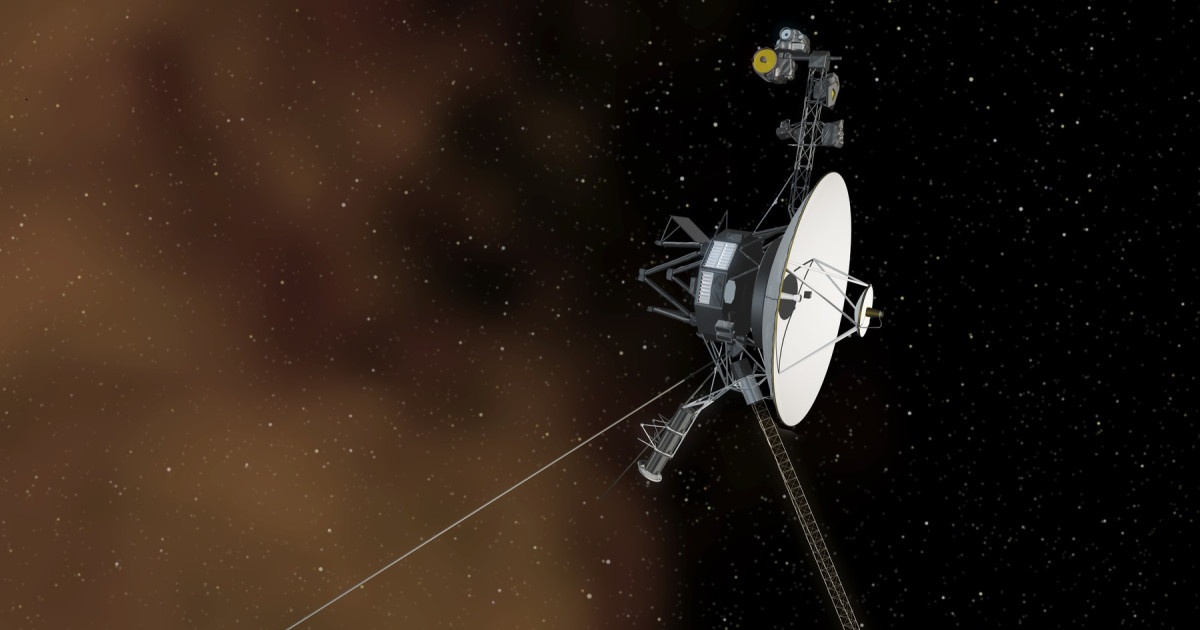
NASA’s Voyager 1 has reached a one-light-day distance from Earth, becoming the first human-made object to cross that threshold. The probe reached the mark on November 18, 2026, roughly 25.9 billion kilometers, or 16.094 billion miles, from Earth.
The distance has a direct operational consequence: a radio signal sent from Earth takes about 24 hours to reach Voyager 1, and a reply needs another 24 hours to return. Any exchange with the spacecraft therefore has a minimum round-trip delay of two days.
Voyager 1 is more than 173 astronomical units from Earth, meaning its distance is over 173 times the average Earth-Sun separation. By comparison, sunlight reaches Earth in about eight minutes and 20 seconds. NASA continues to communicate with the spacecraft through its Deep Space Network antennas in California, Spain and Australia, which can receive its increasingly faint transmissions.
Launched on September 5, 1977, Voyager 1 was originally intended for a roughly five-year investigation of Jupiter and Saturn. It passed its twin, Voyager 2, in December 1977 and has held the title of humanity’s most distant object since overtaking Pioneer 10 in 1998. It is traveling at about 61,000 km/h relative to the Sun.
| Year | Milestone | What happened |
|---|---|---|
| 1977 | Launch | Voyager 1 launched on September 5 and passed Voyager 2 in December. |
| 1979 | Jupiter observations | The spacecraft photographed active volcanoes on Io, providing the first evidence of active volcanism beyond Earth. |
| 1980 | Saturn encounter | Voyager 1 studied Saturn’s rings and moons, including Titan’s dense atmosphere. |
| 1990 | Pale Blue Dot | It photographed Earth from around 6 billion kilometers from the Sun before its cameras were permanently switched off. |
| 2012 | Interstellar space | Voyager 1 crossed the heliopause on August 25, becoming the first spacecraft to directly explore interstellar space. |
| 2024 | Data recovery | NASA bypassed a damaged memory area and restored science data from the spacecraft’s four then-active instruments. |
| 2026 | One light-day | Voyager 1 reached approximately 25.9 billion kilometers from Earth. |
Entering interstellar space does not mean Voyager 1 has completely left the Solar System under the broadest definition. The distant Oort Cloud remains gravitationally bound to the Sun, far beyond the heliopause crossed by the probe in 2012.
A shrinking power budget
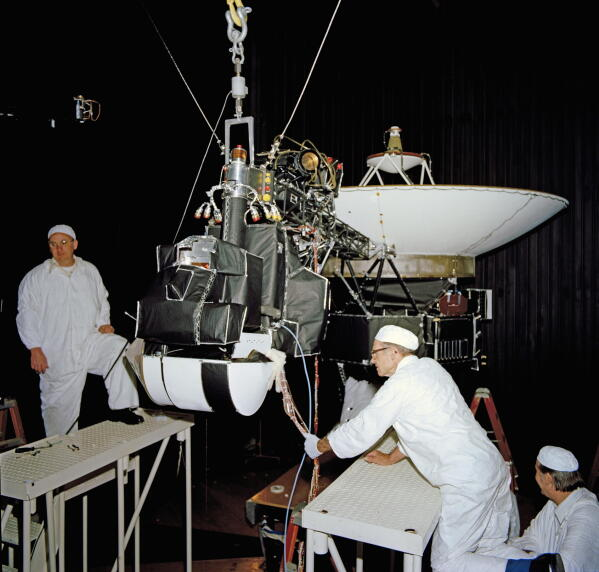
Keeping Voyager 1 operating is now largely an exercise in power management. Its three radioisotope thermoelectric generators convert heat from plutonium-238 decay into electricity. They produced about 470 W at launch, but output has declined by around 4 W per year, leaving the spacecraft with approximately 210 W.
Only two of Voyager 1’s original 10 science instruments remain active:
- Magnetometer (MAG), which measures magnetic fields in interstellar space.
- Plasma Wave Subsystem (PWS), which studies plasma waves and helps estimate electron density in the interstellar medium.
NASA has progressively shut down other systems to conserve energy or because of declining performance. In September 2026, engineers carried out an internally nicknamed “Big Bang” power-saving procedure, switching off three onboard devices and activating three lower-power alternatives. The change saved about 10 W, equivalent to roughly two and a half years of the probe’s annual power loss.
The trade-off is delicate because some equipment also helps preserve temperatures needed for propulsion. If fuel lines become too cold, Voyager 1 could lose its ability to use thrusters to keep its antenna pointed toward Earth.
The milestone followed a brief communications interruption in October. NASA failed to detect Voyager 1’s signal during scheduled contact sessions on October 18 and 19, with communications returning on October 20 before controllers sent a recovery command. NASA reported that a set of thrusters had been disabled and backup systems had taken over automatically; the precise cause remained under investigation.
There is no firm date for the end of the mission, although NASA is seeking to extend operations through further reductions in power use. Voyager 1 will continue moving through interstellar space after communications eventually cease, and is expected to pass within about 1.7 light-years of the star Gliese 445 in roughly 40,000 years.
Voyager 2 also entered interstellar space in 2018, but follows a different, slower trajectory. NASA estimates that it will reach a one-light-day distance from Earth in November 2035.