
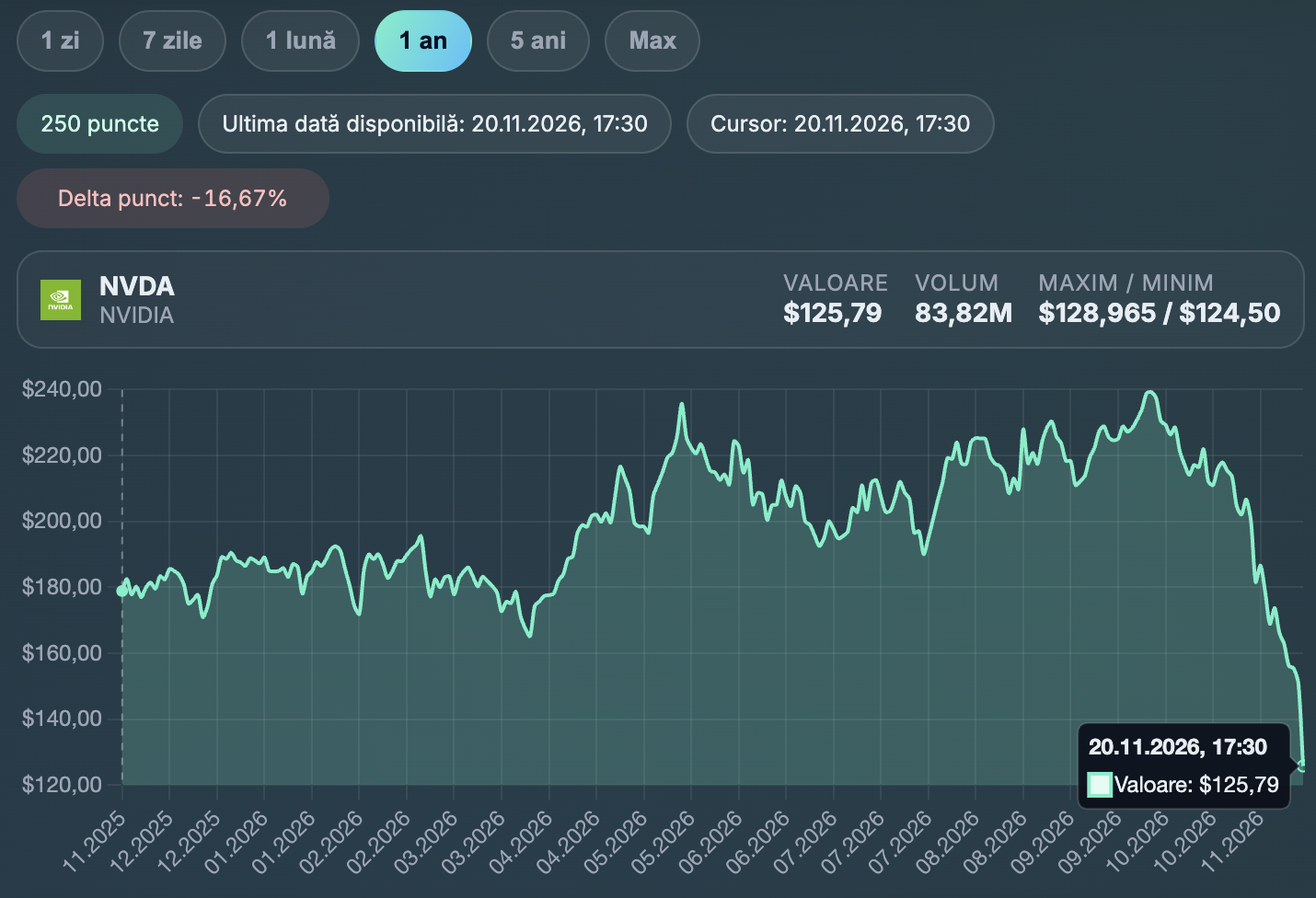
Nvidia’s stock closed at $125.79 on November 20, 2026, down 14% in one session and about 47.5% below its October 6 closing price of $239.24. The move left the AI-chip company with a closing market capitalization of roughly $3.034 trillion, versus $5.777 trillion six weeks earlier.
Based on closing values, the decline erased approximately $2.743 trillion in market capitalization. The Kobeissi Letter put the loss at as much as $2.88 trillion using a higher intraday October reference point, but its characterization as a historic record has not been independently verified.
| Metric | October 6, 2026 | November 20, 2026 |
|---|---|---|
| Nvidia share price | $239.24 | $125.79 |
| Market capitalization | $5.777 trillion | $3.034 trillion |
| Change from October 6 | — | -47.5% |
The market-capitalization change reflects the market value of Nvidia’s outstanding shares, rather than cash lost from the company’s accounts. Nvidia continues to sell AI hardware and generate revenue, but investors have assigned a substantially lower value to its future earnings than they did in early October.
Regulatory report and AI-spending concerns add pressure
Reuters reported on November 20 that the U.S. Securities and Exchange Commission was examining potential accounting issues at Nvidia, including aspects of revenue reporting and commercial relationships across the AI-infrastructure industry. An investigation does not establish that the company committed any violation.
The sell-off also comes as investors reassess whether the technology sector’s enormous AI-infrastructure spending can deliver sufficient returns. Nvidia has been a central beneficiary of the buildout, supplying accelerators for data centers alongside related server, memory and networking demand.
The companies cited as major AI-infrastructure spenders include:
- Microsoft
- Amazon
- Meta
Nvidia’s decline was part of a broader technology-market retreat. The S&P 500 fell 3.7% on the day and was more than 10% below its October high, while the Nasdaq dropped 5.3% and moved into negative territory for the year, according to the reported closing data.
Other semiconductor stocks reported as heavily affected included:
- AMD
- Micron
- Broadcom
Nvidia reportedly fell about 23% across five trading sessions. The next major question for the wider hardware supply chain is whether scrutiny of AI returns leads large technology companies to slow data-center orders, a shift that could extend beyond accelerators to memory, servers and networking equipment.