Huawei says the Mate X8 reduces the height difference across its foldable display’s crease area to 15 microns, using a magnetic correction system designed to pull down raised sections while supporting the recessed center from below. The company’s 3D scan figures put the result at 0.015 mm—more than 18 times lower than the 273-micron measurement it reported for the Mate X6.
The approach addresses a familiar foldable-display problem. Repeated folding places display layers under compression and tension, leaving a shallow center depression and slight raised areas around it after the device is opened. Those variations can make the crease more visible, particularly in reflected light.
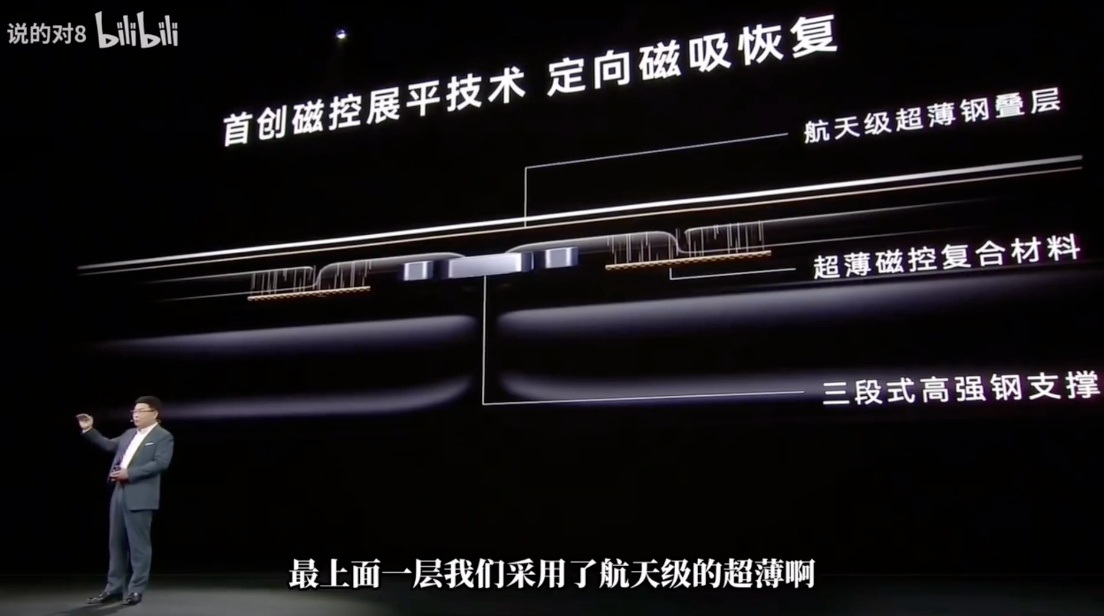
Huawei’s system combines mechanical support with directed magnetic force rather than relying solely on hinge geometry or flexible glass. According to the company, the magnetic material doubles the display’s shape-recovery speed, while the steel laminate achieves a 99.9% recovery rate after bending.
- A three-section high-strength steel support structure pushes up the recessed center of the display from underneath.
- A 0.1 mm magnetic composite applies directional attraction to raised areas near the crease.
- An ultra-thin steel laminate, said to offer 140% higher bending rigidity, helps the assembly return to its original shape.
- Precision 3D printing compensates for microscopic irregularities in the support structure with 5-micron accuracy.
A nine-layer anti-reflective treatment on the flexible display is also rated to reduce light reflection to 0.9%, which should further limit the visual prominence of the fold line.
Huawei’s reported crease measurements
| Model | Fold-area height difference | Reduction versus predecessor |
|---|---|---|
| Huawei Mate X6 | 273 microns | — |
| Huawei Mate X7 | 142 microns | 48% |
| Huawei Mate X8 | 15 microns | 89.4% |
Other foldable makers are pursuing the same goal through different hardware choices. OPPO’s Find N6 uses a 3D-printed titanium hinge, a larger curvature radius and flexible glass that acts like a spring to restore the panel’s shape. Samsung’s Galaxy Z Fold8 uses Flex Titanium technology, built around a titanium-alloy film and a titanium support plate.
Huawei’s differentiator is the use of magnetic attraction for localized screen-geometry correction after the phone is unfolded. The company’s 15-micron result is based on its own measurement data; longer-term, like-for-like durability testing will be needed to show how effectively that surface flatness is retained after extensive folding cycles.