

A publicly accessible database containing nearly 2 billion password, email and login records has been taken offline after security researcher Jeremiah Fowler reported it to its hosting provider. The exposure is especially concerning because some of the data could enable attackers to take over an already authenticated browser session, potentially avoiding both password entry and two-factor authentication checks.
Fowler, writing in an ExpressVPN investigation, identified 8,471 directories of unencrypted information, with some apparently sorted by victims’ country. He said it was the largest collection he has found, more than 13 times larger than a 149 million-record database he identified earlier this year.
The records reference accounts and email addresses associated with major online services, but their presence does not establish that those companies’ own servers were breached. A single email address can appear across many services, and the database may include duplicates, expired passwords and data from older incidents.
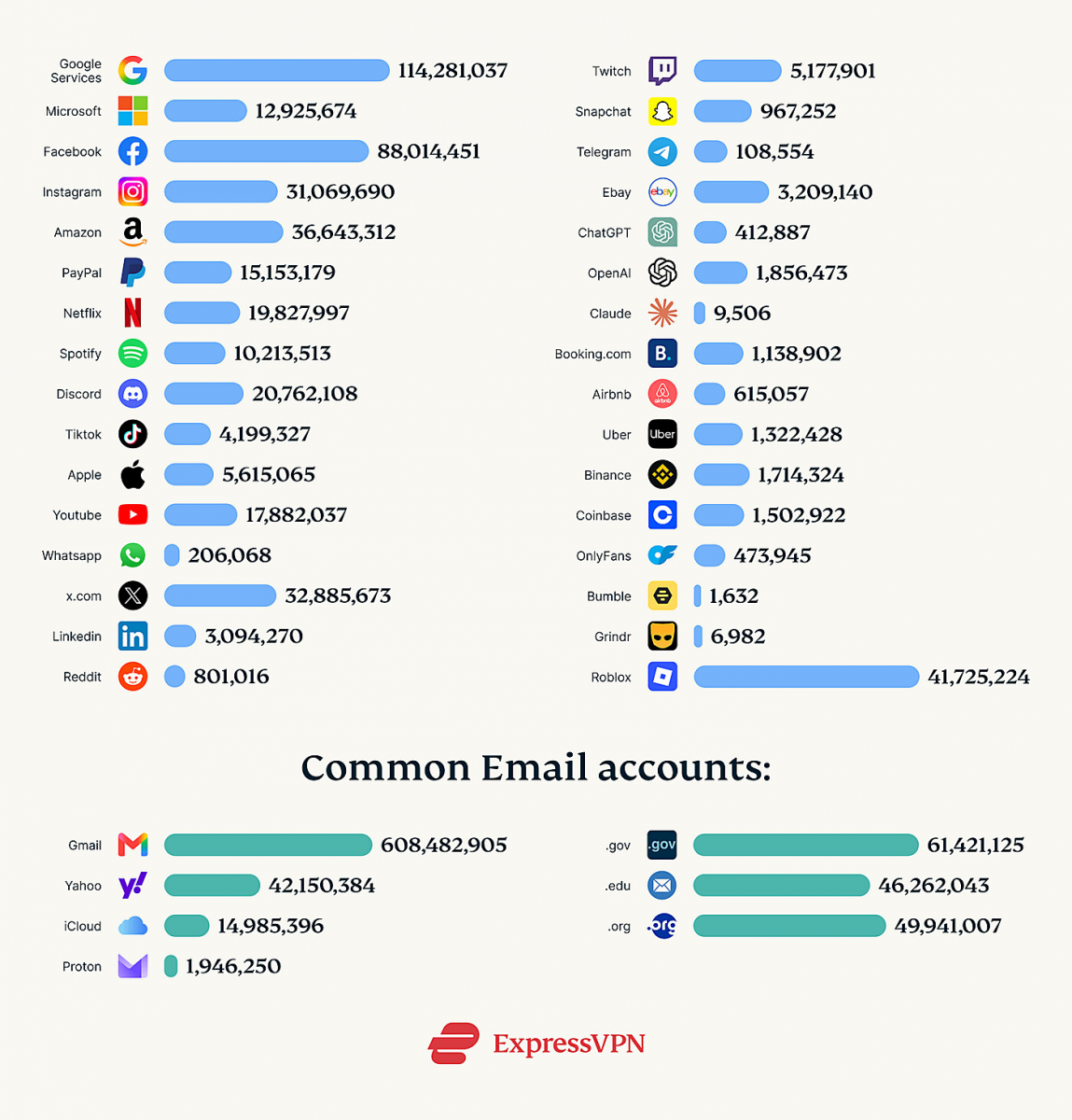
Services and email domains appearing in the records
- Google services: 114,281,037 identified records; Gmail addresses: 608,482,905
- Facebook: 88,014,451
- Roblox: 41,725,224
- Amazon: 36,643,312
- X: 32,885,673
- Instagram: 31,069,690
- Discord: 20,762,108
- Netflix: 19,827,997
- YouTube: 17,882,037
- PayPal: 15,153,179
- Microsoft: 12,925,674
- Spotify: 10,213,513
- TikTok: 4,199,327
- OpenAI: 1,856,473
- ChatGPT: 412,887
- Claude: 9,506
- Addresses using .gov domains: 61,421,125
- Addresses using .org domains: 49,941,007
- Addresses using .edu domains: 46,262,043
- Yahoo addresses: 42,150,384
- iCloud addresses: 14,985,396
- Proton addresses: 1,946,250
Around 400,000 of the documents Fowler analyzed appeared to come from malware designed to steal credentials and session information. Such infostealers can extract browser cookies, saved passwords and other data from a compromised PC or phone. An attacker with a valid session token may be able to access an account without triggering the normal sign-in flow, so a stolen cookie can be valuable even when an account has two-factor authentication enabled.
Google has begun addressing that specific threat with Device Bound Session Credentials, or DBSC, introduced in Chrome 146 for Windows in April 2026. The mechanism cryptographically binds an authenticated session to the device where it was created, using hardware components such as the TPM. If cookies are copied to another machine, they expire quickly and their renewal requires the cryptographic key that remains on the original device.
DBSC must also be adopted by online services, rather than the browser alone. It complements passkeys, which can significantly reduce phishing exposure but do not automatically protect a session that is already active on an infected device.
What to do after a suspected credential theft
Changing a password is not enough if malware remains on the device, since it may capture the replacement password as well. The recommended sequence is to remove the suspected device from the network, scan it for malware, then use a separate trusted device to secure accounts.
- Disconnect the suspected device from the internet and scan it with security software.
- From another device, change passwords, starting with the primary email account.
- End active sessions and remove unfamiliar devices in account settings.
- Review recovery email addresses, phone numbers and third-party apps with account access.
- Use unique passwords for every service and enable two-factor authentication or passkeys where available.
- For Gmail, review account security settings and any automatic email-forwarding rules.
- Check whether an email address appears in known breaches through Have I Been Pwned.
The database was blocked a few days after the hosting provider was notified. It remains unknown who assembled the collection and whether anyone copied its contents before public access was removed.