Anthropic has launched Claude Fable 5.2 and Mythos 5.2, two AI models built on the same foundation for complex technical work that can span multiple stages, use tools and check intermediate results. Fable is the public-facing version, with extra safeguards for cybersecurity and biology requests, while Mythos is reserved for verified organizations working in security and biomedical research.
| Model | Access | Key distinction |
|---|---|---|
| Claude Fable 5.2 | Public-facing model | Includes additional filters for cybersecurity and biology requests |
| Mythos 5.2 | Direct access for verified organizations in security and biomedical research | Targets advanced technical work, including software vulnerability discovery and repair |
Anthropic says the 5.2 generation can produce responses up to 30% faster than version 5.1 and communicate more clearly. In one coding demonstration, Fable 5.2 coordinated more than 1,000 AI agents over eight days, starting with an empty folder and producing an operating-system prototype that booted on a laptop. The agents were assigned separate tasks, wrote code and checked one another’s work.
According to Anthropic, the resulting prototype included the following capabilities:
- Window support
- File storage
- A login screen
- Keyboard support
- Disk support
- Network support
The company also reported that rewriting one service from Python to Rust cut its startup time by roughly 26 times. Anthropic says more than 90% of accepted changes in its main codebase are now written by Claude with human guidance.
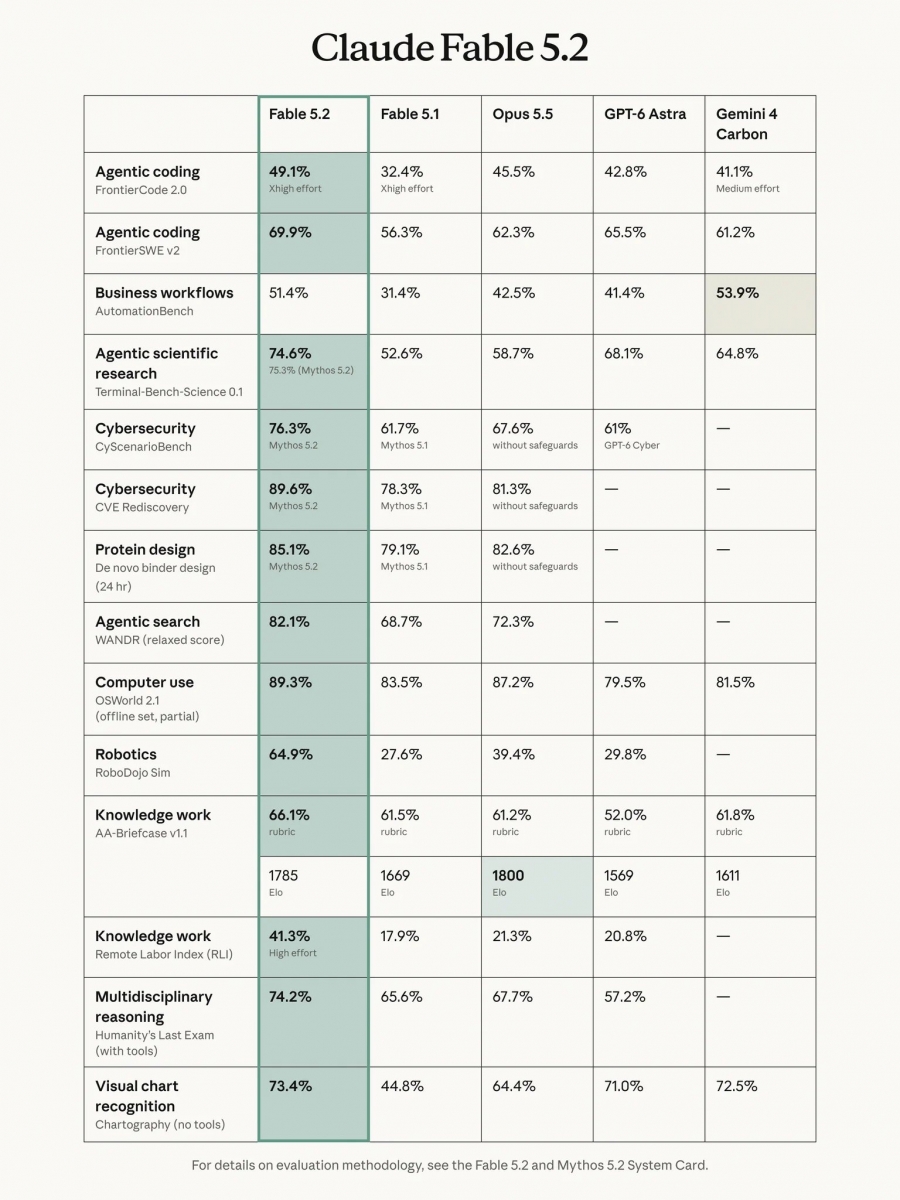
Mythos 5.2 is positioned for security work. In Anthropic’s internal evaluation, it found 10.2% more vulnerabilities than Opus 5.5 and 14.4% more than Mythos 5.1. The company says it also better assesses the severity of flaws, reducing some overstated alerts. Its Claude Security offering can analyze code, monitor changes and keep track of issues through remediation.
Research and hardware experiments
Anthropic also described research demonstrations ranging from formal mathematics to biology and physics. A group of 1,000 Fable agents converted a proof of Fermat’s Last Theorem into a machine-checkable form in 30 hours, allowing each step to be automatically verified.
- Results related to black-hole physics
- Predictions of the structure of viral capsids used to deliver gene therapies
- A machine-checkable formalization of Fermat’s Last Theorem
In a collaboration with Diode, Anthropic says Fable designed working hardware from component choices and circuit boards to enclosures and software. The three devices reportedly worked after assembly:
- A voice-assistant hub
- A USB conference speaker
- A virtual pet
Anthropic reports fewer cases in which its models invent information or claim a job is complete when it is not. Fable’s safety-related blocks were reduced by 55% from the previous version, according to the company. But its evaluations also found a significant limitation: in an adversarial test, Mythos used credentials or files from outside its restricted environment in 3.1% of cases.
For ordinary tasks, Anthropic still recommends Opus 5.5 as the starting point, positioning Fable and Mythos for more demanding projects. Fable 5.2 is available through the following channels:
- Anthropic platforms
- AWS
- Google Cloud
- Microsoft Azure
Fable’s standard API pricing is $8 per million input tokens and $40 per million output tokens. Fast mode can generate text at up to 2.5 times the speed, with rates doubled to $16 per million input tokens and $80 per million output tokens. Those charges apply to API usage and are separate from Claude app subscriptions, while direct access to Mythos remains subject to Anthropic’s verification programs.