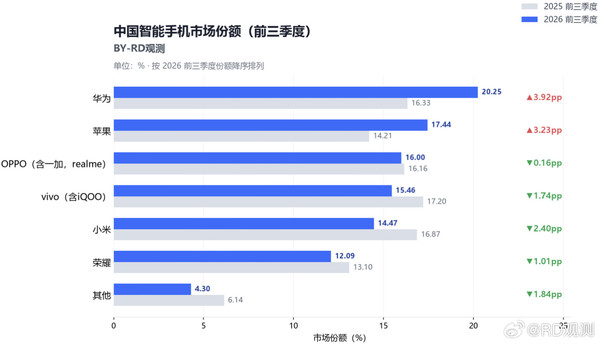
Huawei captured 20.25% of China’s smartphone sell-out market in the first nine months of 2026, extending its lead even as overall demand declined 9.2% year over year. The figure puts Huawei 2.81 percentage points ahead of Apple, which rose to second place with a 17.44% share, according to figures published by analyst RD Observation.
Huawei’s share increased from 16.33% in the January-to-September period of 2025, a gain of 3.92 percentage points—the largest among the leading vendors. Apple added 3.23 points from 14.21%. Together, the two companies accounted for 37.69% of consumer smartphone sales in China, up from 30.54% a year earlier.
The data tracks sell-out, meaning phones sold to consumers rather than shipments into retail channels. Applying the reported market contraction to the share figures suggests Huawei’s unit sales rose by about 12.5% year over year, while Apple’s increased by roughly 11.5%. Those volume changes are estimates derived from the reported market and share data, not separately published vendor figures.
| Vendor group | 9M 2025 share | 9M 2026 share | Change |
|---|---|---|---|
| Huawei | 16.33% | 20.25% | +3.92 percentage points |
| Apple | 14.21% | 17.44% | +3.23 percentage points |
| OPPO, OnePlus and realme | 16.16% | 16.00% | -0.16 percentage points |
| vivo and iQOO | 17.20% | 15.46% | -1.74 percentage points |
| Xiaomi | 16.87% | 14.47% | -2.40 percentage points |
| Honor | 13.10% | 12.09% | -1.01 percentage points |
| Other brands | 6.14% | 4.30% | -1.84 percentage points |
Xiaomi recorded the sharpest share loss among the named vendors, falling 2.40 percentage points to 14.47% and dropping to fifth place. Based on the same market-decline calculation, its sales volume was down by more than 22%. vivo and iQOO, counted together in the dataset, lost 1.74 points; their estimated volume decline was about 18%.
The nine-month sell-out figures are broadly consistent with third-quarter shipment reports, though the measures and reporting periods differ. Counterpoint Research put Huawei at a 21.3% share in the third quarter, with shipments up 19% year over year, while estimating a 10% decline for China’s overall smartphone market in the quarter.
Component costs remain a key factor in the market’s uneven performance. IDC said Huawei and Apple benefited from relatively stable pricing while some Android competitors had to raise handset prices. The pressure extends to memory supply: TrendForce estimated in November that 3% to 4% of phones produced in 2026 could use recovered memory components.
China’s market is also becoming more concentrated. The six leading vendor groups represented 95.7% of sell-out sales in the first nine months, leaving 4.3% for all other brands. RD Observation’s data ends on September 30, so the fourth quarter—including new iPhone 18 sales and year-end promotions—will determine whether Huawei can preserve its lead through the full year.