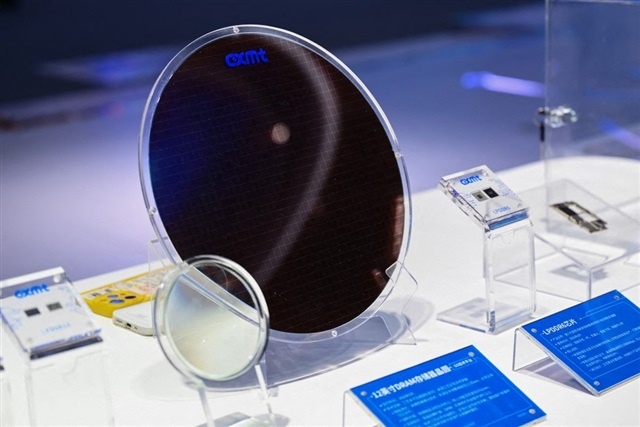
Huawei and ChangXin Memory Technologies (CXMT) are scheduled to unveil new memory technologies at ISSCC 2027 in February, placing their work in the same technical session as presentations from Samsung and SK Hynix. Huawei’s paper covers a custom high-bandwidth memory architecture for AI processors, while CXMT is set to show a 32Gb DDR5 chip rated for 9,200 MT/s.
| Company | Technology scheduled for ISSCC 2027 | Key disclosed specifications |
|---|---|---|
| Huawei | Custom HBM | 64 channels, 4,096 data lines and five stacked layers |
| CXMT | DDR5 | 32Gb capacity, 9,200 MT/s and vertical transistors |
| Samsung | HBM4E | 48GB capacity and 17Gb/s per pin |
| SK Hynix | DDR5 | 16Gb capacity, vertical transistors and stacked peripheral circuitry |
Huawei’s design uses wafer-on-wafer hybrid bonding, a technique that directly joins stacked silicon layers through highly dense interconnects. Its architecture integrates memory controllers and uses a 4,096-line data interface. Capacity and per-pin transfer speed have not been disclosed, so it cannot yet be compared directly with Samsung’s HBM4E implementation.
CXMT’s DDR5 announcement represents a step up from the company’s 24Gb, 8,000 MT/s chips presented in November 2025. The new part raises per-chip capacity by 33% and speed by 15%. A 32Gb chip equals 4GB, meaning a 32GB memory module could be built with eight chips.
The company’s approach combines vertical transistors, with the gate arranged around the channel, and direct silicon-wafer connections using copper contacts. That technical direction is significant for higher-density PC memory, but a conference presentation does not establish high-volume manufacturing readiness.
Manufacturing remains the critical question
CXMT has reached roughly 10% of global DRAM market revenue, making it the fourth-largest producer. Its ability to scale advanced memory remains less certain, however. A Reuters report published October 28 said CXMT’s HBM3E yields were estimated at 20% to 30%, compared with about 70% for SK Hynix.
Advanced HBM is strategically important for domestic AI accelerators, while a larger-scale challenger to Samsung, SK Hynix and Micron could eventually reshape supply across phones and PCs. Apple is already testing CXMT memory for iPhone and MacBook products, according to the reported information. The key issue for the technologies scheduled for ISSCC will be whether their makers can turn the disclosed designs into volume production.