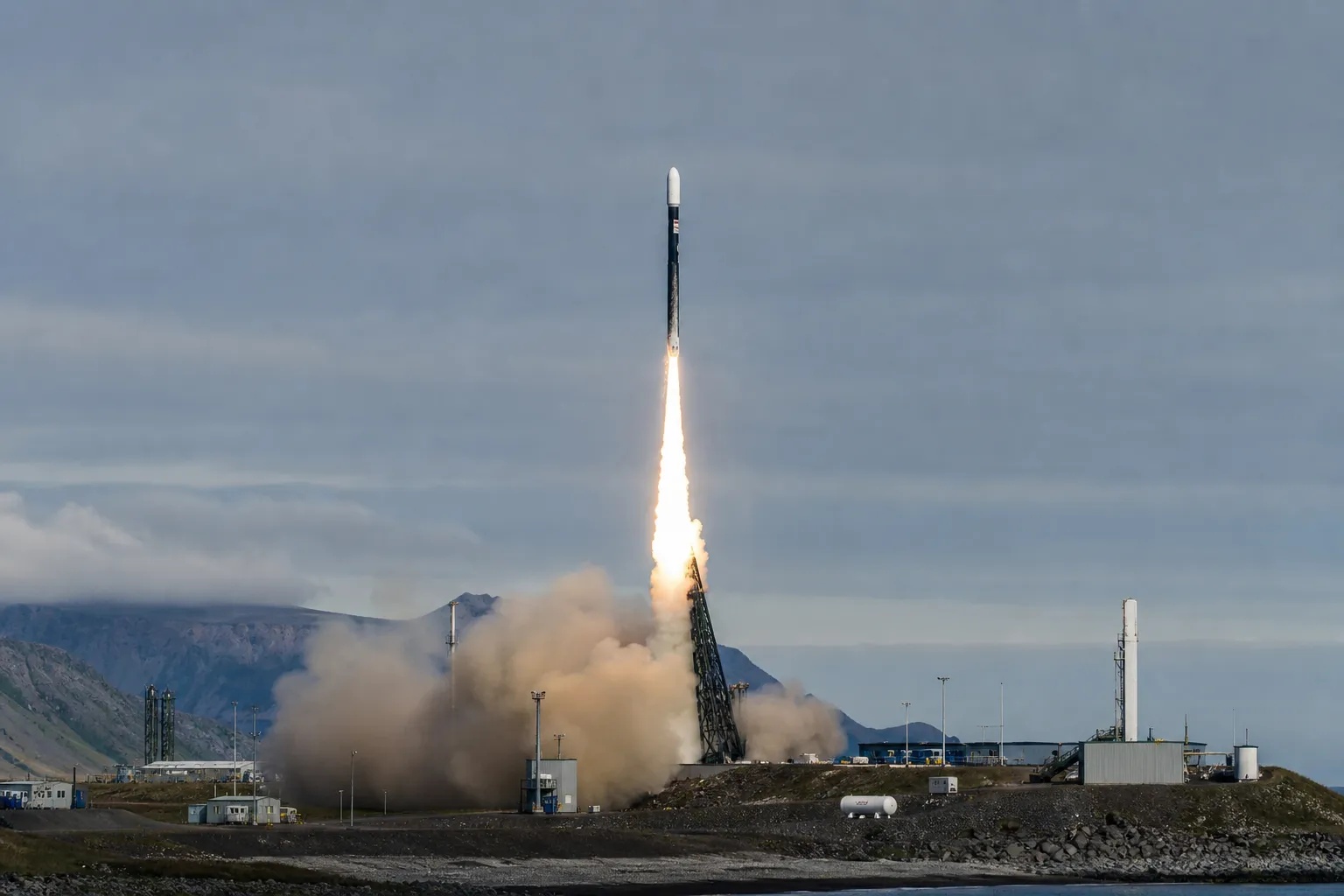
Isar Aerospace has reached orbit with its Spectrum rocket, delivering five CubeSats and one experiment on the vehicle’s second flight. The mission, called “Onward and Upward,” lifted off from Andøya Spaceport in Norway on September 5 and marks the first successful orbital delivery for the German launch startup.
Spectrum’s first launch attempt in 2025 ended roughly 30 seconds after liftoff. For the second mission, the payloads were selected through the European Space Agency’s Boost! program, giving the rocket an early operational demonstration beyond a test flight alone.
The 28-meter, two-stage launcher uses 10 engines and is aimed at the small- and medium-satellite market. Isar lists a maximum payload capability of 1,000 kg to low Earth orbit and 700 kg to sun-synchronous orbit.
That puts Spectrum in a different class from SpaceX’s Falcon 9, which has a stated maximum payload capacity of 22,800 kg to low Earth orbit and operates with routinely recovered and reflown first stages. Spectrum is not reusable, and Isar’s near-term challenge will be establishing reliable launch cadence and competitive pricing for dedicated satellite missions.
Europe already has Ariane 6 and Vega-C launch systems, but Spectrum adds a privately developed vehicle to a sector historically led by institutional programs. Isar says Spectrum vehicles numbered three through seven are already in production, while a roughly 40,000-square-meter facility near Munich is being prepared for larger-scale manufacturing.
The orbital success answers the initial technical question for Spectrum: it can deliver payloads to orbit. The next test is whether Isar can turn that achievement into repeatable commercial launches as competition intensifies from established providers and emerging reusable launch systems elsewhere.