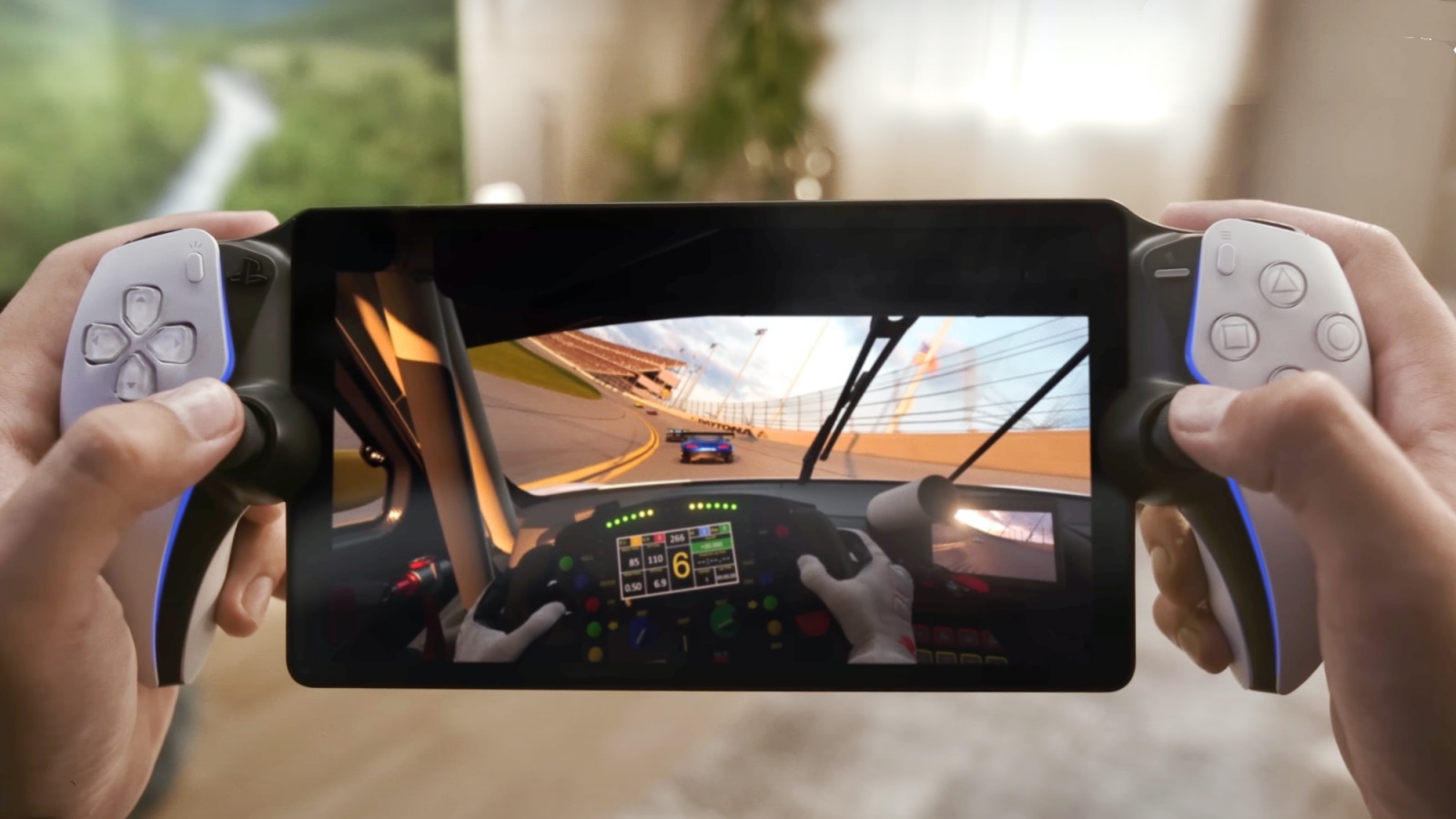
Sony’s rumored Project Canis handheld may rely on aggressive image reconstruction rather than console-class native rendering, according to a new leak. The device is said to render games at 540p and upscale them to 1080p using a purported PSSR 3.0 technology, with frame generation also listed as part of the approach.
The report remains unconfirmed. Sony has not announced Project Canis, the “PSP 3” label sometimes attached to the device, or a PSSR 3.0 version. Its claimed late-2027 launch window is also rumor rather than an official schedule.
The leak describes an AMD-built 3 nm APU with four Zen 6c CPU cores, two Zen 6 LP cores, 24 GB of LPDDR5X memory on a 192-bit bus, and a 16-compute-unit RDNA 5 GPU. It would reportedly operate within a 15 W to 25 W power envelope, substantially below the power draw of a home console such as the PlayStation 5 Pro.
Rumored Project Canis specifications versus PS5 Pro
A comparison published by GameGPU places the alleged handheld beside the PlayStation 5 Pro, but its PSSR “effective performance” figures are source estimates, not additional hardware TFLOPS. Upscaling and frame generation can improve output resolution and perceived motion performance, but they do not turn the underlying GPU into a higher-TFLOPS processor.
| Specification | PlayStation 5 Pro | Project Canis (rumored) |
|---|---|---|
| CPU | Zen 2 cores | 4 × Zen 6c + 2 × Zen 6 LP |
| GPU | 60 CUs, custom RDNA 2/3 architecture, about 2.18 GHz | 16 RDNA 5 CUs, 1.2–1.65 GHz |
| Memory | 16 GB GDDR6 + 2 GB DDR5 | 24 GB LPDDR5X, 192-bit bus |
| Power draw | About 215–240 W under load | 15–25 W |
| Upscaling | “PSSR 2.0,” according to the source | “PSSR 3.0” plus frame generation, according to the leak |
| Render resolution / target | 1080p / 1440p to 4K | 540p to 1080p |
| FP32 compute | 16.7 TFLOPS | 4.91 TFLOPS handheld / 6.75 TFLOPS docked |
| Estimated PSSR “effective performance” | — | 10–11 TFLOPS handheld / about 14 TFLOPS docked |
In the reported handheld configuration, the GPU would run at 1.2 GHz for 4.91 TFLOPS of FP32 compute. Docking the system would reportedly raise the clock to 1.65 GHz and roughly 6.75 TFLOPS. The substantially lower power budget explains why the reported design centers on low-resolution rendering and reconstruction instead of matching PS5 Pro’s raw graphics throughput.
Sony already uses PlayStation Spectral Super Resolution on PS5 Pro, and the dossier says the company released an improved version of the AMD Project Amethyst-developed algorithm in 2026. Whether a future handheld could deliver convincing Full HD output from a 540p base image would depend on the final reconstruction quality and frame-rate stability, neither of which can be evaluated from the leak.
Project Canis has previously been linked to a PlayStation handheld separate from the unannounced PlayStation 6. Until Sony confirms the hardware, its chip configuration, clocks, upscaling features, product name, and release timing should all be treated as provisional.