Boston Dynamics has equipped its Atlas humanoid robot with new hands designed for more precise industrial manipulation. Each hand now has 13 degrees of freedom, up from seven previously, giving Atlas more independently controlled movements for gripping, repositioning and orienting objects.
The upgrade is aimed at tasks that go beyond simply picking up a component. Atlas is being prepared for work including automotive assembly, where it needs to hold parts securely, adjust their position in constrained spaces and operate tools made for human workers.
- Each hand has 13 degrees of freedom, compared with seven on the previous design.
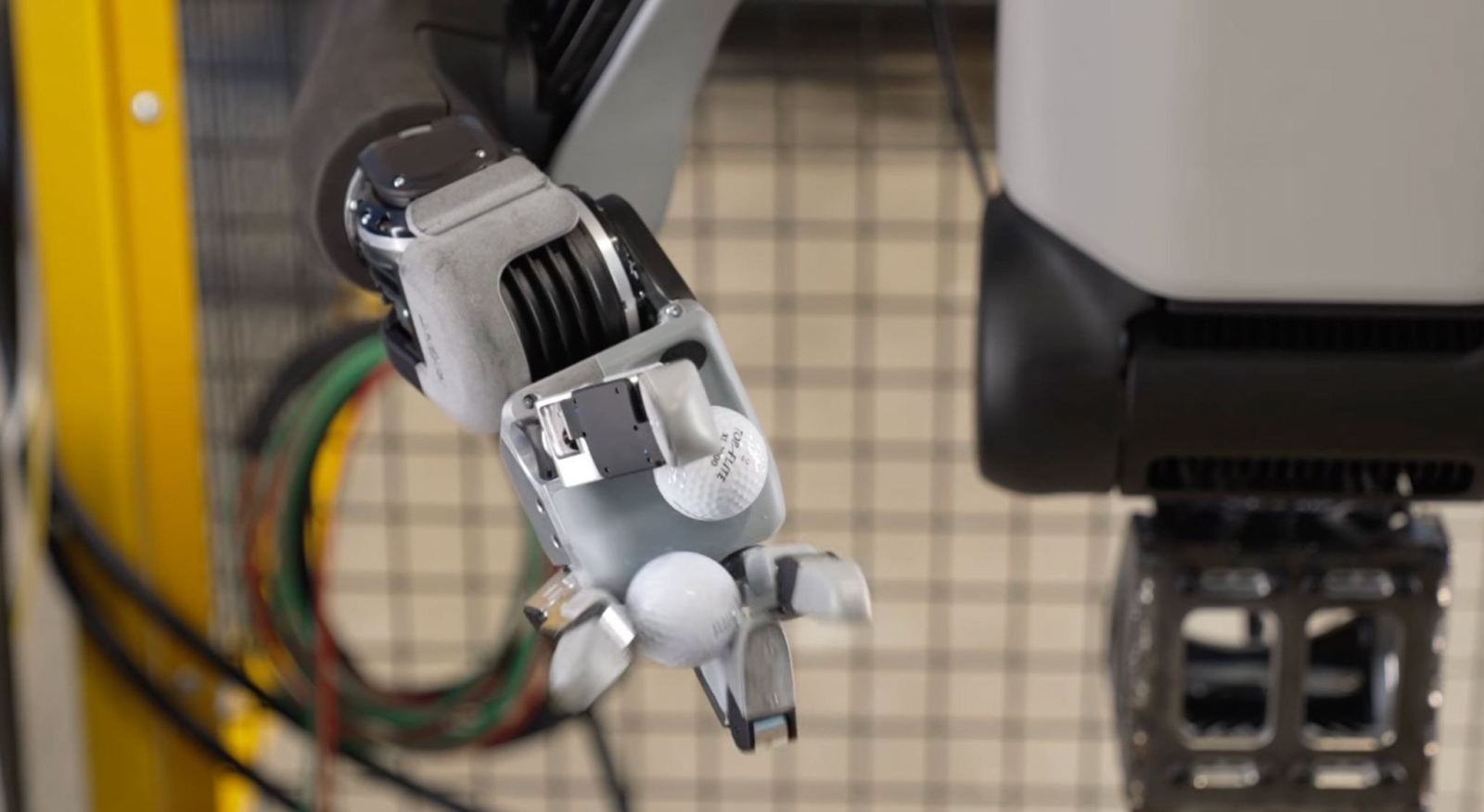
- The design uses four fingers: an opposable thumb and three other fingers, with no little finger.
- Pressure-sensitive tactile sensors on the fingers and palm help the robot detect contact with objects.
- The thumb has four degrees of freedom, while each of the other fingers has three.
Boston Dynamics opted against a fifth finger because it determined that the added mechanisms, cost and complexity were not justified by the benefit. Engineer Dylan Thrush said the hand is somewhat larger and stronger than a typical human hand.
The company’s demonstrations show different levels of autonomy. Atlas manipulated two golf balls in the same hand autonomously, but the sequence in which it handled a drill was controlled remotely by an operator. The latter demonstration therefore shows the hardware’s potential rather than fully autonomous tool use.
That distinction remains important for humanoid robotics: a hand may be mechanically capable of a complex motion before the robot can independently learn and execute the task. Boston Dynamics is also researching ways for Atlas to acquire new behaviors with less task-specific training.