Google has begun a gradual rollout of Gemini 4 Neon, a new AI model positioned between its Carbon and Hydrogen offerings. Google says Neon is designed for complex coding, analysis and scientific research workloads at a lower cost than Carbon, while retaining more capability than its fastest and least expensive model, Hydrogen.
- Gemini API through Google AI Studio.
- Gemini for businesses.
- Google Antigravity for Google AI Pro and Google AI Ultra subscribers.
- The Gemini app’s model selector for Google AI Pro and Google AI Ultra subscribers.
At the API level, Neon costs $3 per million input tokens and $15 per million generated tokens. Google says that at the default “high” reasoning setting, Neon costs 32% less per task than Carbon.
| Model | Input tokens, per 1 million | Generated tokens, per 1 million |
|---|---|---|
| Gemini 4 Neon | $3 | $15 |
| Carbon | $4 | $20 |
| Hydrogen | $1.50 | $7.50 |
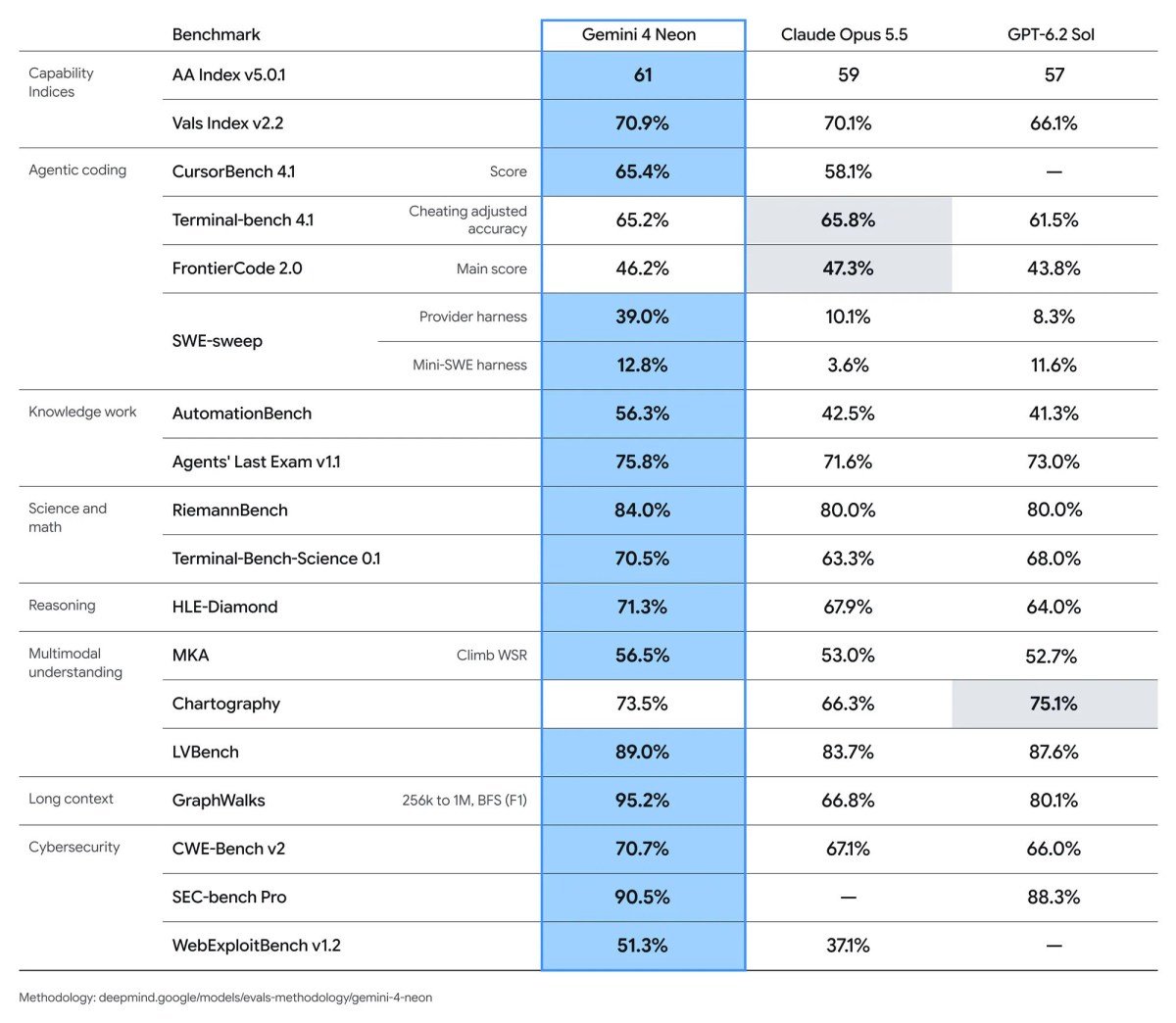
Google’s published benchmarks place Neon ahead of Claude Opus 5.5 and GPT-6.2 Sol in the two reported aggregate measures below. Claude Opus 5.5 remains slightly ahead in Terminal-Bench 4.1 and FrontierCode 2.0, according to Google’s results.
| Benchmark | Gemini 4 Neon | Claude Opus 5.5 | GPT-6.2 Sol |
|---|---|---|---|
| Artificial Analysis Intelligence Index | 61 | 59 | 57 |
| Vals Index | 70.9% | 70.1% | 66.1% |
Neon supports a one-million-token context window and four reasoning levels, topped by an “xhigh” setting. Within Google Antigravity, it can split a task among multiple Hydrogen subagents working in parallel. Google also says internal testing gave Neon the lowest rate of false statements among its models.
A cybersecurity-focused Neon version is due in the coming days for verified specialists in the Fairwind program, marking the next announced stage of the rollout.