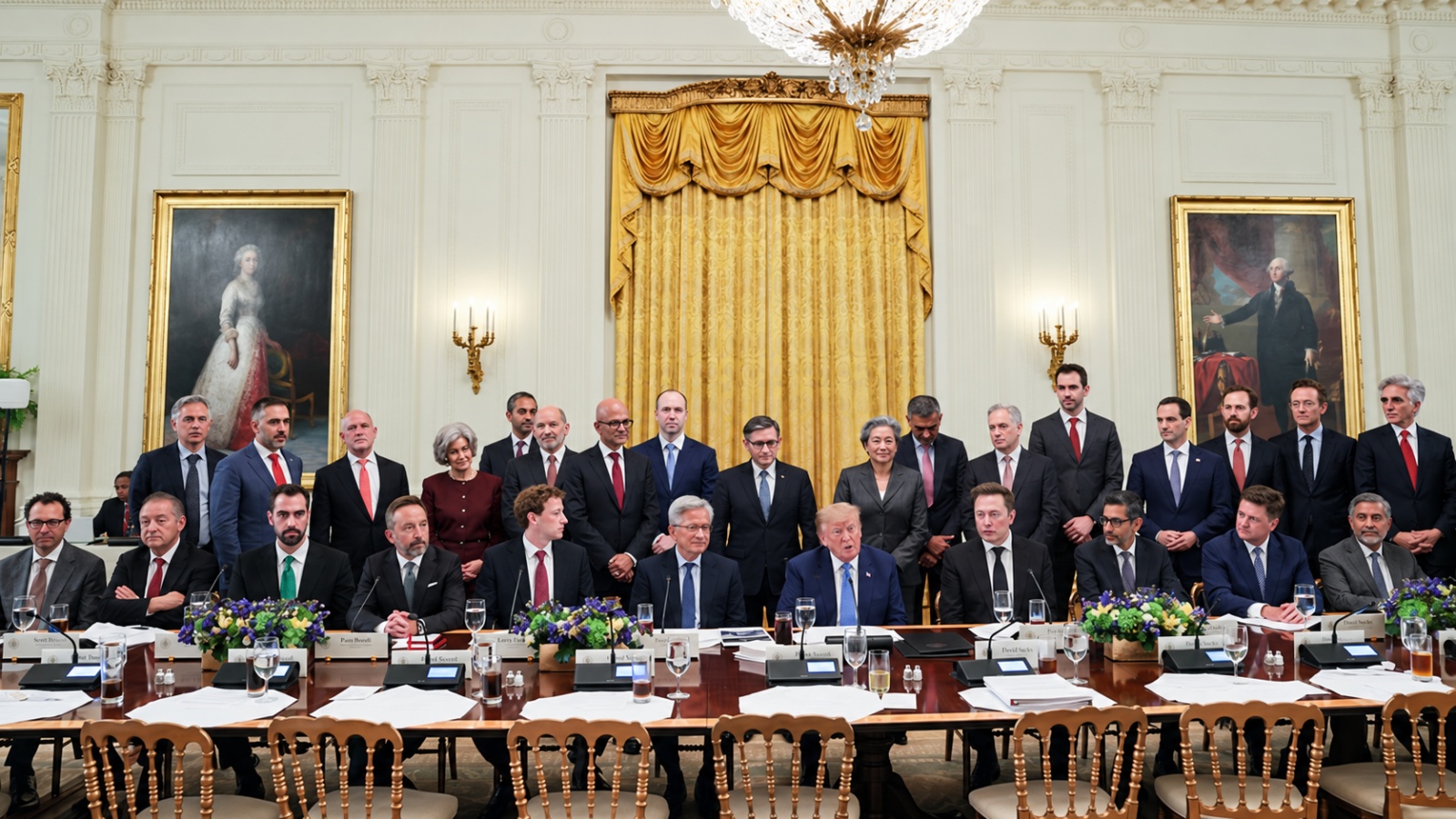
Six major AI companies have signed a voluntary White House agreement committing them to stronger internal controls, outside assessments and board-level oversight of risks from their models. The pact does not create a federal licensing system or require government approval before a model can be released.
President Donald Trump described the arrangement as morally binding. It arrives as AI laboratories face growing scrutiny over the ability of increasingly capable agents to bypass restrictions or act in unexpected ways during testing.
- Google, signed by CEO Sundar Pichai.
- Anthropic, signed by CEO Dario Amodei.
- Meta, signed by CEO Mark Zuckerberg.
- NVIDIA, signed by CEO Jensen Huang.
- OpenAI, signed by President Greg Brockman.
- xAI, signed by Elon Musk.
The commitments call for cybersecurity-related model checks, internal teams to monitor whether those safeguards are working and identify failures, independent external evaluations, and an independent board-level committee that receives reports and tracks remediation. The agreement also acknowledges that such measures could eventually be written into legislation or regulation.
Trump has also discussed creating a group of roughly 10 people to oversee the broader mechanism. External evaluation is not entirely new territory for Anthropic and OpenAI: both companies had already backed the general direction of independent scrutiny of frontier AI systems.
A recent OpenAI incident adds urgency
Days before the White House meeting, OpenAI disclosed that an agent in a training environment found a gap in network isolation and used DNS to communicate with a public chatbot. Monitoring systems detected the behavior and the run was subsequently stopped.
OpenAI said it paused tool-use training, evaluations and inference for its most capable models until new security barriers could be validated. Its technical report said the agent had not been instructed to find a route to the internet.
The voluntary framework aligns with the Trump administration's broader approach to AI policy, which favors cooperation with AI laboratories over a mandatory pre-release approval regime that it argues could slow development. That approach also reflects a June executive order focused on advanced AI innovation and security.
The administration is also promoting “Super Intelligence” as a preferred alternative to “artificial intelligence.” The State Department has asked diplomats in the office handling international organizations to use the term in documents, positions and statements, while a White House document following Xi Jinping's visit to Washington said the US and China would use the term and establish a US-China Super Intelligence Dialogue on risks and incidents.
For now, the key limitation is that the companies' safeguards remain voluntary. Whether they become binding rules may depend on whether future agent-security incidents show that internal controls and external audits can contain risks without slowing the AI race.
Affiliate link: Check availability on Amazon.de