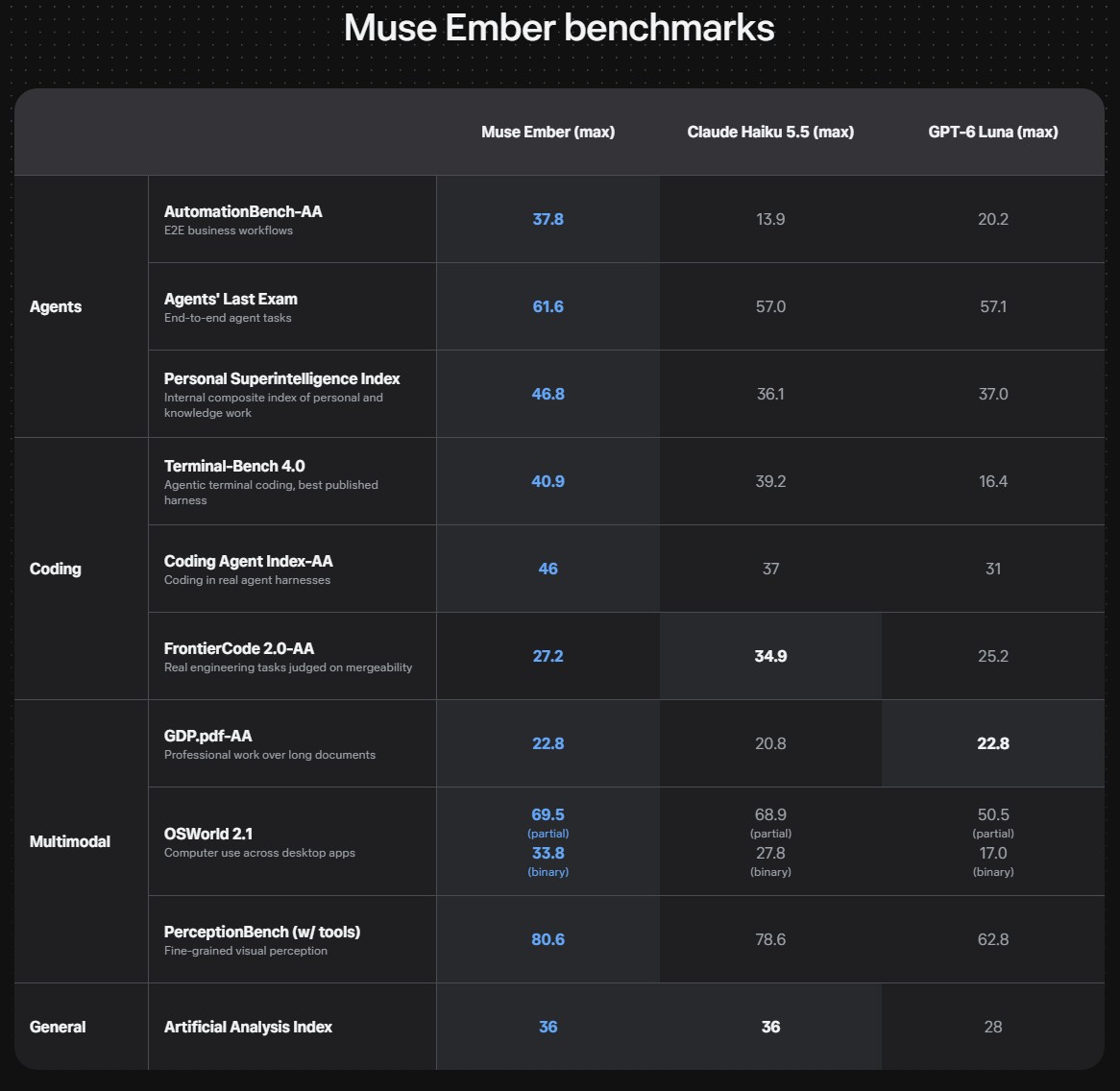
Meta has launched Muse Ember, a compact multimodal model designed for AI agents that handle repetitive work such as document analysis, code generation and software-tool use. The company is positioning the model around lower operating costs, claiming a stronger performance-to-price ratio than Claude Haiku 5.5 and GPT-6 Luna across reasoning settings.
According to Meta, Muse Ember can match Claude Haiku 5.5’s best results at roughly one-third of the cost. It accepts text, images, audio and video, allowing it to interpret screenshots, charts, scanned documents and meeting recordings, while also interacting directly with a computer.
The model supports a context window of up to 1 million tokens and can generate responses of up to 512,000 tokens. For coding tasks, it can read files, run tests and make targeted changes. Meta recommends pairing it with Muse Wonder for more difficult projects, with the latter handling planning duties.
API pricing and availability
Muse Ember is offered as muse-ember-1.0 through Muse Code and the Meta Model API. Meta lists the following rates:
- Input tokens: $0.10 per 1 million tokens
- Generated tokens: $0.50 per 1 million tokens
- Cached input tokens: $0.004 per 1 million tokens
Artificial Analysis tests give Muse Ember a score of 36, narrowly behind Muse Spark 1.3 at 37. The more substantial difference is reported task cost: $0.14 for Muse Ember, compared with $2.39 for Muse Spark 1.3. Meta says the model has also undergone safety testing covering cyber risks and autonomous behavior.
Muse Ember is also available through Google Cloud and Oracle Cloud. Its real-world standing will depend on whether its low task-cost advantage holds up across broader agentic workloads against larger and more established competing models.