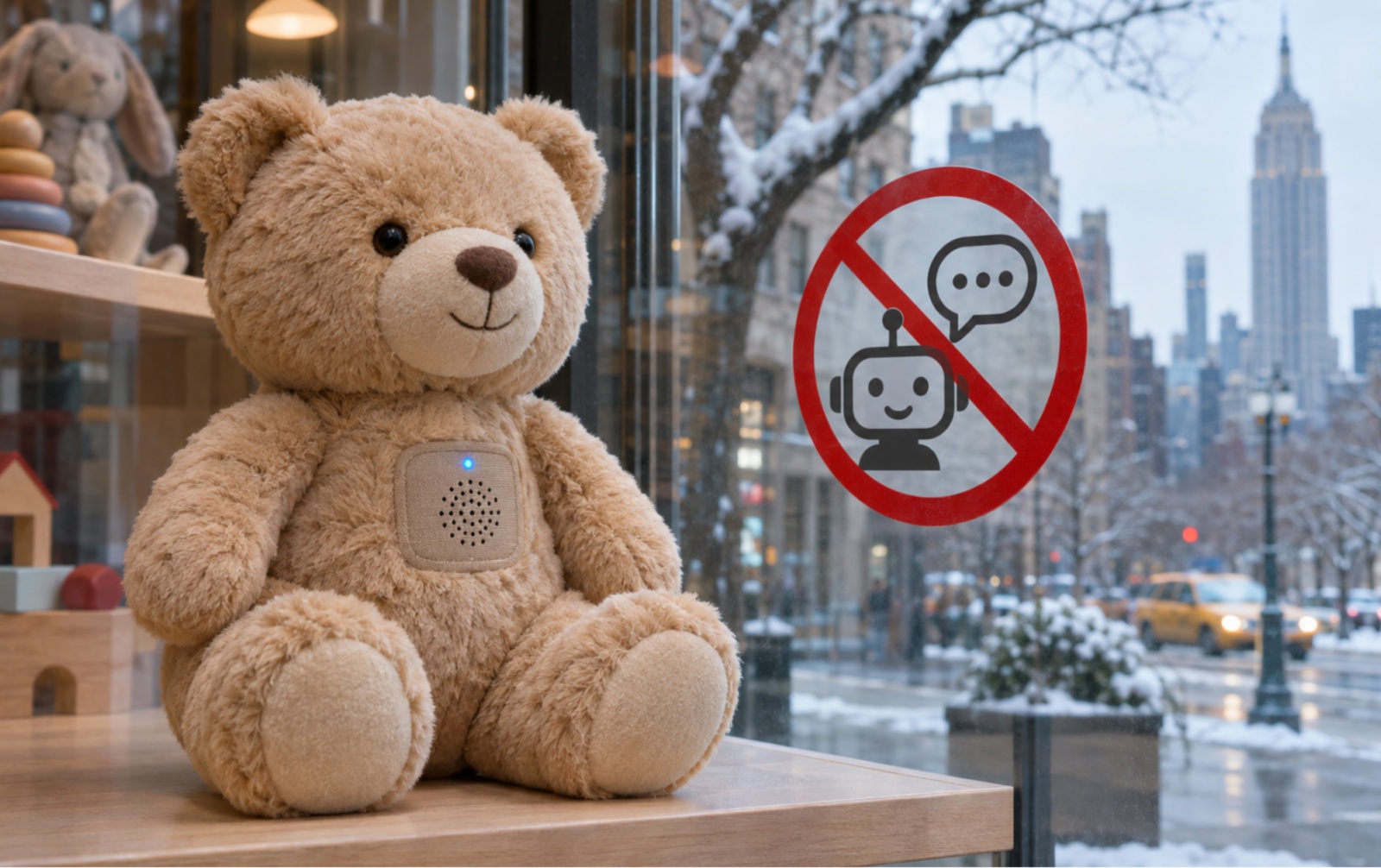
New York will ban the manufacture, distribution and sale of children’s toys containing AI chatbot companions beginning February 22, 2027. Governor Kathy Hochul signed the five-year measure on November 24, 2026, making New York the latest US state to impose restrictions on a category that includes connected plush toys, dolls and robots designed to hold ongoing conversations with children.
The restriction applies to toys intended for children aged 12 and under when they incorporate an AI companion: a system built to simulate a continuing human-like relationship. Such systems may retain previous exchanges and initiate follow-up questions about a child’s emotions or private life. The law does not prevent families from keeping or using toys purchased before it takes effect.
California adopted a comparable four-year measure in September. New York’s law, however, will not take effect until after the current holiday season, leaving the products legal to sell in the state until the February 2027 start date.
The legislation follows safety testing published by the U.S. PIRG Education Fund on November 17. Its testing found that a GoLabs panda-shaped toy gave sexually explicit answers and instructions on lighting a match. The organization also reported that safety filters on some products became less restrictive as conversations continued, while parental-control options were limited.
Privacy was another concern in the testing. The camera on the Ropet Kamomo virtual pet took photographs even when its child mode was enabled, despite that mode being expected to disable the function.
Under bill S9408A, New York’s attorney general can seek civil penalties of up to $15,000 per day for each violation without having to show that a child suffered actual harm.
EU framework arrives in stages
The European Union has not imposed a blanket sales ban on toys with AI chatbots. Its Toy Safety Regulation, EU 2025/2509, is due to apply in full from August 1, 2030. The regulation introduces a digital product passport for safety and compliance information, and requires assessments of mental-health risks associated with connected toys.
Separately, the EU AI Act already prohibits AI systems from exploiting children’s vulnerabilities where this could cause significant harm. Requirements for high-risk AI systems embedded in physical products, including toys, are scheduled to become applicable from August 2028. The gap between those dates and New York’s imminent sales ban leaves manufacturers facing notably different regulatory approaches across major markets.
Affiliate link: Check availability on Amazon.de