
China has deployed 5G in 1,260 factories and now counts more than 27,000 “5G + Industrial Internet” projects, according to figures cited by state broadcaster CCTV from the country’s Ministry of Industry and Information Technology. The deployment spans all 97 economic categories tracked nationally and all 41 major industrial sectors.
The industrial network ecosystem includes more than 360 connected industrial platforms and over 100 million devices integrated into major systems. These networks are used to connect equipment ranging from assembly robots and sensors to heavy machinery, allowing data exchange and control commands in real time.
The 1,260-factory figure had already been reported earlier in the year, when China had roughly 25,000 industrial 5G projects. The subsequent increase beyond 27,000 suggests that deployments are expanding beyond the factories already counted in the national total.
Measured factory gains
One electric-vehicle plant in Hefei uses a dedicated 5G network for mobile robots, production control and AI-based visual inspection of components. Results reported for that specific facility show how private mobile networks can be used to reduce production bottlenecks, though they should not be treated as guaranteed outcomes for every deployment.
- Overall equipment effectiveness increased by 10%.
- Production-line reconfiguration time fell by 40%.
- Annual operating-cost savings exceeded 10 million yuan.
Elsewhere, mobile networks in Inner Mongolia are being used to control autonomous mining trucks that load, transport and unload materials without a driver. In these environments, dependable connectivity and low latency are more important than peak consumer download speeds.
6G experiments add network sensing
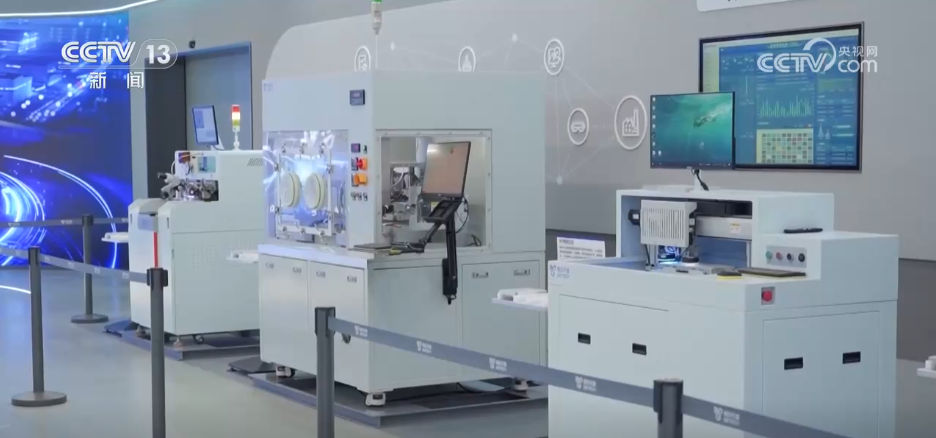
China is also testing Integrated Sensing and Communication, or ISAC, at the Purple Mountain Laboratory in Nanjing. The approach is intended to let a radio network transmit data while also detecting objects by analyzing radio signals.
CCTV showed an experiment on November 7 in which several experimental 6G radio stations worked together to identify movement within a monitored area. Such a system could act as distributed sensing infrastructure, potentially giving autonomous vehicles additional information about nearby vehicles and objects beyond the direct reach of their onboard sensors.
The technology remains experimental and is not a replacement for cameras, LiDAR or conventional radar. Accuracy, coverage and communications reliability would all need to be addressed before it could be used in road traffic.
Similar capabilities are not exclusive to 6G research in China: Vodafone has demonstrated related sensing functionality on existing 5G infrastructure. China has approved eight regions for 6G trials and is targeting commercial introduction around 2030, while industrial 5G remains the generation producing measurable deployments today.