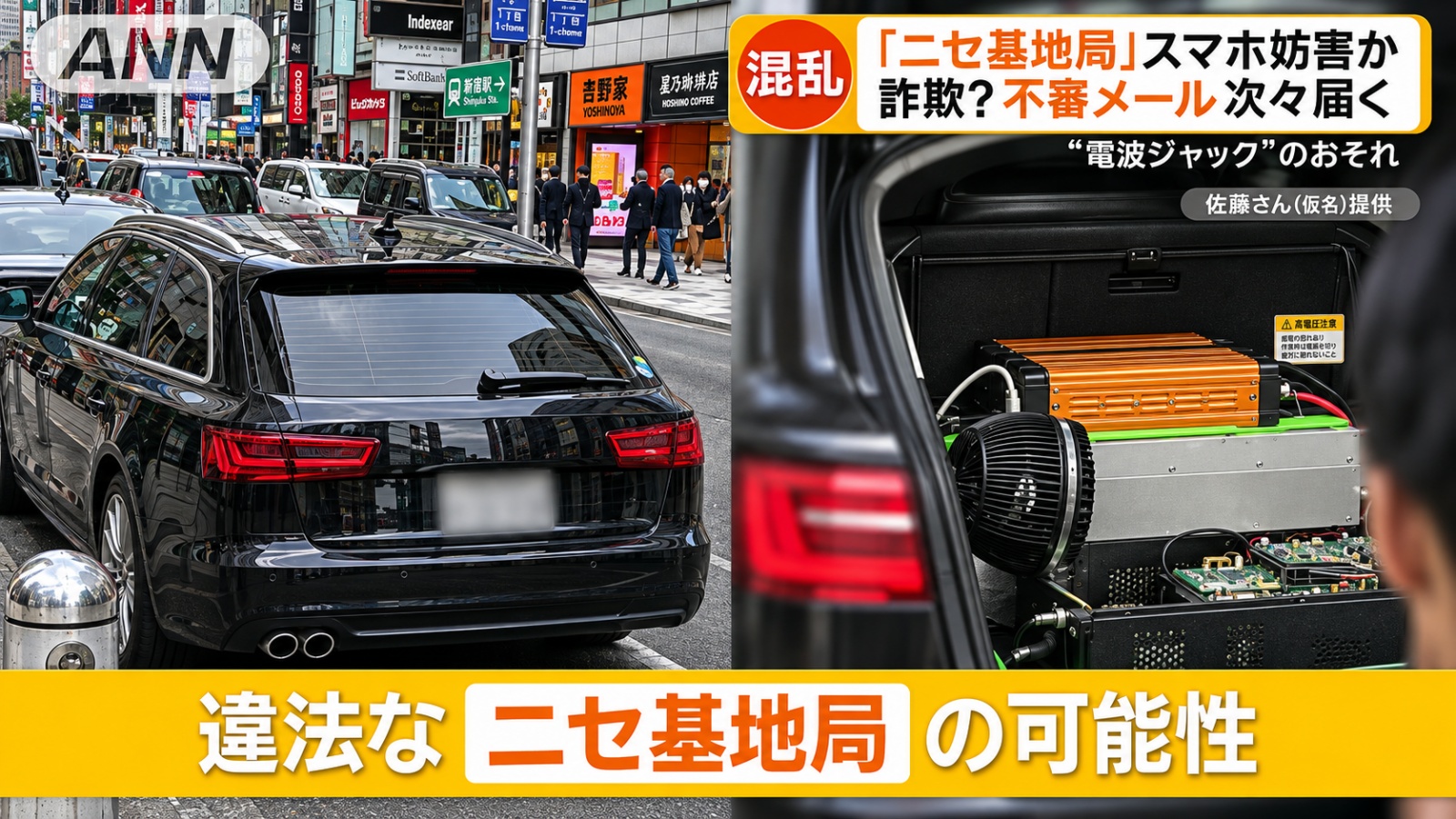
Japanese authorities have arrested a 31-year-old man after an unauthorized radio transmitter, allegedly capable of impersonating a mobile base station, disrupted service for more than 10,000 phones in Tokyo’s Ginza district. The device is also being investigated in connection with phishing SMS messages that may have caused losses for at least 18 people.
The incident occurred on November 7, 2026, in Ginza, with interference reported across an area of roughly 500 meters over less than two hours. According to the Kanto Regional Telecommunications Bureau, police found the radio equipment hidden beneath the rear seat of a vehicle, with its power supply stored in the trunk. The transmitter was reportedly operating when officers intervened.
Investigators suspect the equipment disrupted normal 4G and 5G connections, prompting compatible nearby devices to seek an alternative network connection. The alleged fake base station could then present itself as a 2G network and distribute fraudulent text messages without relying on a conventional mobile operator.
- Interfere with the legitimate cellular signal, temporarily dropping nearby phones’ 4G or 5G service.
- Offer a fraudulent 2G connection to devices that still support the older standard.
- Send SMS phishing messages linking recipients to fake pages designed to collect personal and banking information.
The reported 10,000 affected devices were subject to radio interference; that figure does not mean all of those phones were compromised or that their owners lost data. For the banking fraud to succeed, recipients would still need to open a phishing link and enter information on a fraudulent site.
Police are investigating reports that the Chinese-language messages warned recipients that their payment cards or accounts had been compromised or would be blocked. The suspected losses total about ¥4 million. Authorities are examining whether the seized equipment was connected to those cases, which reportedly affected Chinese tourists in particular.
Why 2G remains an attack surface
Commercial 2G service in Japan was shut down years ago, but some smartphones retain 2G support for compatibility. That legacy fallback can be exploited because 2G lacks the stronger network-authentication protections used by more modern cellular standards, making it easier for a rogue transmitter to pose as a legitimate network.

Google’s Android security documentation identifies 2G fallback as a risk in fake-base-station attacks. On compatible Android phones, users can disable 2G in the SIM or mobile-network settings; the option may appear as “Allow 2G.” Some Android 16 devices instead offer “2G network protection,” which must be enabled to block 2G connections. Settings and availability vary by manufacturer and hardware.
Turning off 2G can reduce exposure to this type of downgrade attack, though it may affect coverage in areas or roaming locations where legacy networks are still used. Emergency calls are exempted from the restriction. Android 16 also adds alerts for insecure mobile networks on hardware that supports the feature, including warnings for unencrypted connections and suspicious device-identity requests.
The suspect denies the allegations. Authorities are now investigating the origin of the equipment and whether a larger group was involved, following earlier reports of unexplained mobile-signal loss in Ginza, Shibuya and Shinjuku.