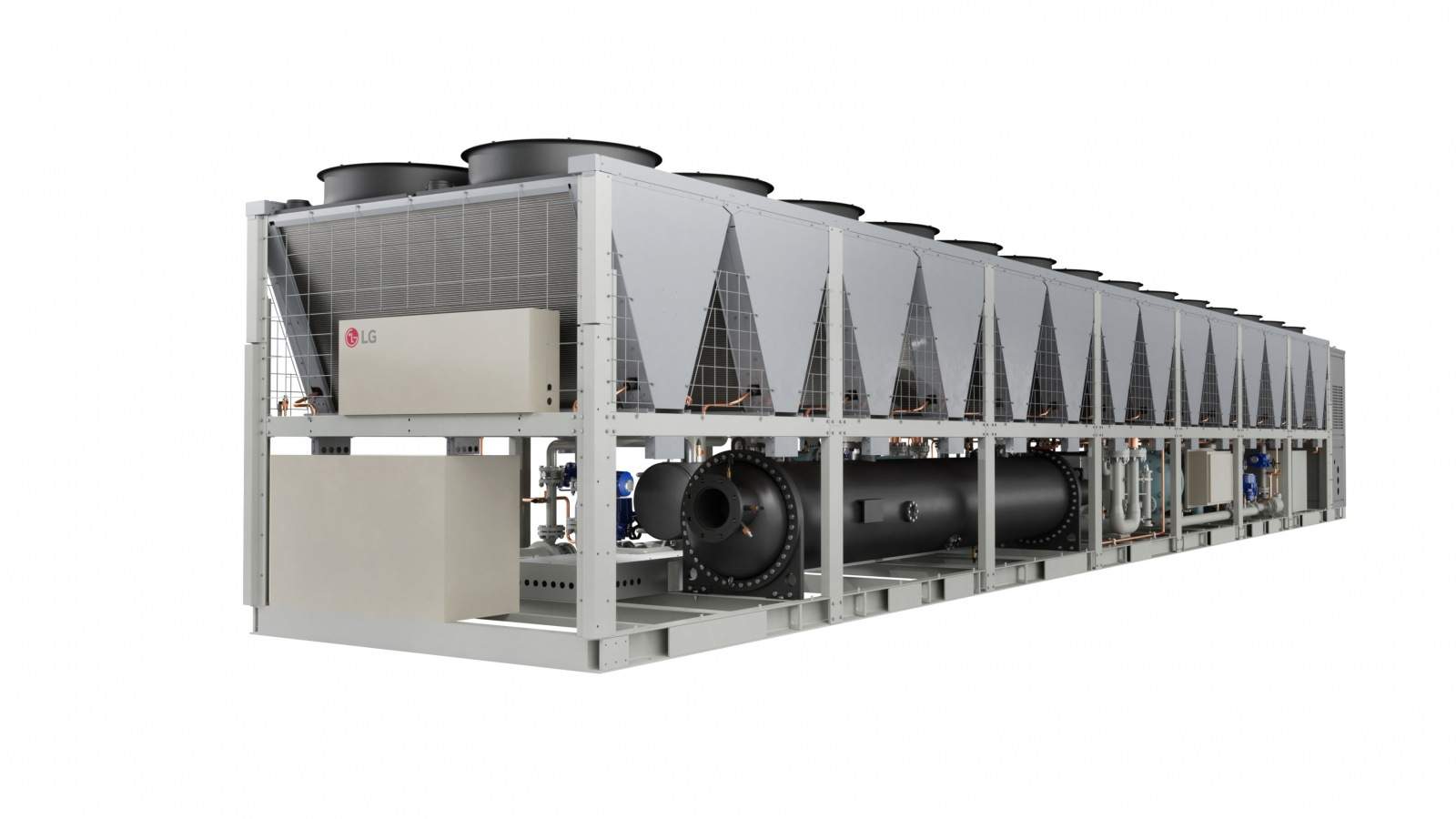
LG has launched an air-cooled centrifugal chiller designed for AI data centers, with models rated from 480 to 600 refrigeration tons (RT), equivalent to approximately 1.7 MW to 2.1 MW of cooling capacity per unit. The equipment is intended to remove heat from the data center’s water infrastructure rather than blow cooled air directly onto GPU racks.
The chiller can serve as part of a wider thermal chain: cooling water can feed computer-room air handlers for facility cooling or support coolant distribution units (CDUs) that move liquid closer to processors and AI accelerators. In that setup, the chiller is the large-scale component that ultimately transfers heat away from the building.
Its centrifugal compressor uses magnetic bearings, keeping the rotating shaft suspended without mechanical contact during normal operation. That eliminates a conventional oil-lubrication circuit, reducing friction losses and removing associated maintenance components.
LG also uses refrigerant-based free cooling. When outdoor temperatures are low enough, outside air can assume more of the thermal load and reduce compressor work. The company’s design circulates refrigerant directly, avoiding an intermediate heat exchanger and the glycol loop used in some conventional systems.
LG says the approach can reduce energy use by around 30% compared with waterside free cooling, but the figure comes from the company’s internal simulation rather than a year-long commercial data-center measurement. The simulation modeled a 1,750 kW unit operating at full capacity under climate conditions in the Seoul metropolitan area.
| Cooling approach | Annual energy use in LG simulation | Simulation conditions |
|---|---|---|
| Refrigerant-based free cooling | 1,044,824 kWh/year | 1,750 kW unit at 100% capacity; Seoul metropolitan climate |
| Waterside free cooling | 1,479,655 kWh/year | 1,750 kW unit at 100% capacity; Seoul metropolitan climate |
Actual results will depend on local climate, water temperatures, IT load and the design of the full cooling installation. The chiller also uses LG’s Series Counter Flow technology to distribute cooling demand between compressors as the load changes.
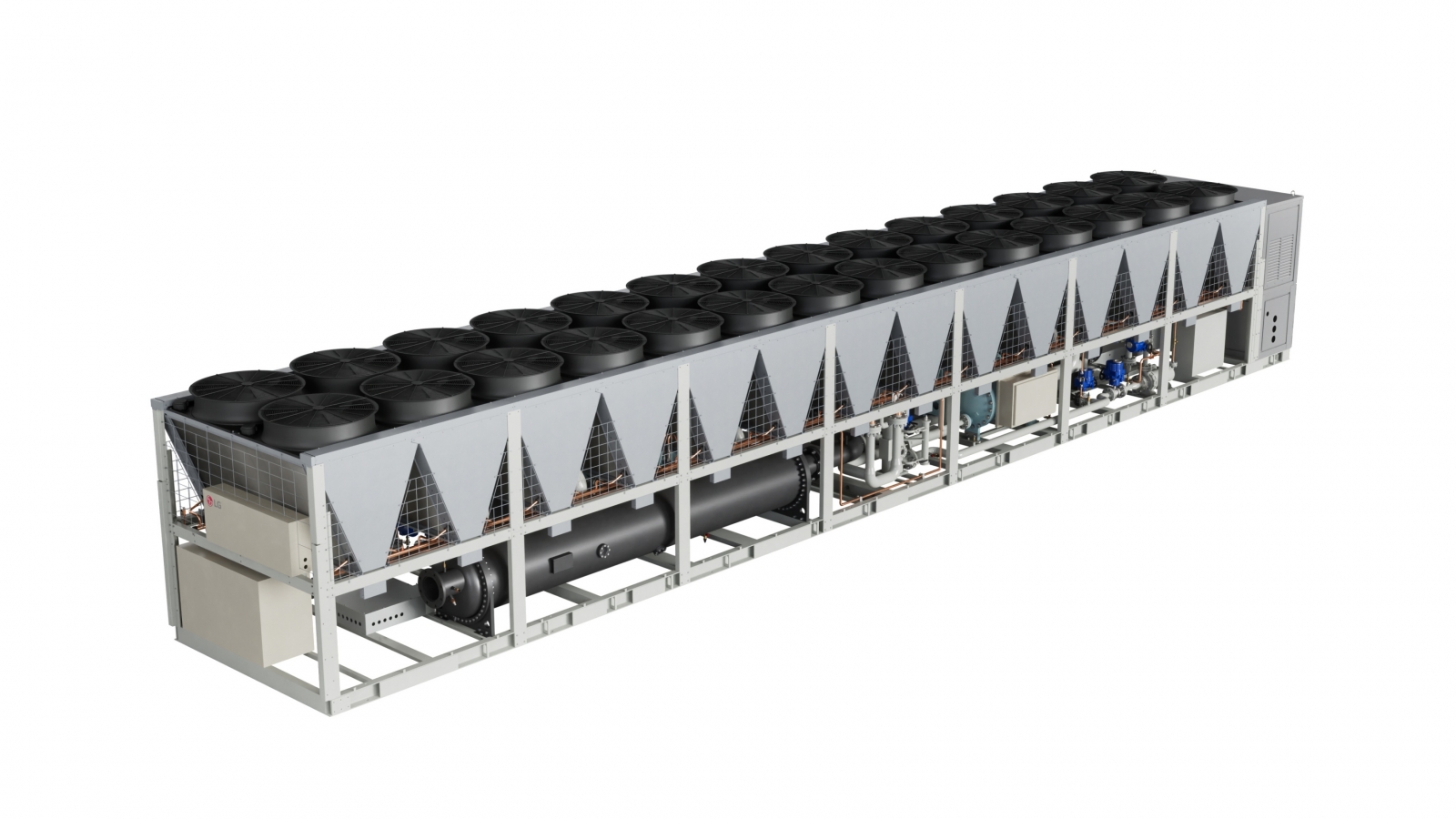
An integrated UPS is intended to keep the systems needed for the magnetically levitated shaft powered during an outage, allowing it to stop safely rather than supplying megawatt-scale cooling for an extended period. LG says the system can return to full cooling capacity within three minutes after power is restored, although that result can vary with test conditions. Machine-learning algorithms monitor compressor behavior to help reduce the risk of surge, an instability in centrifugal-compressor airflow.
A broader AI cooling portfolio
The new chiller is part of LG’s effort to build out what it calls a chip-to-chiller cooling chain. The company already has a 2.6 MW CDU qualified as NVIDIA DSX Ready for direct-to-chip cooling; that NVIDIA qualification applies to the CDU, not to the newly announced chiller.
LG has also joined the NVIDIA Partner Network as a Power and Cooling Solution Preferred Partner. Its CDU lineup includes models with 600 kW, 1 MW and 2.6 MW capacities that have completed different NVIDIA qualification processes, while a 4 MW model is in development.
LG is additionally preparing a modular hydronic solution that integrates chilled-water pumps and a thermal-storage buffer tank in a prefabricated module. Such systems could let operators add cooling capacity as new racks are deployed, without rebuilding the entire plant each time. LG has not detailed pricing or market-by-market availability for the new chiller.