Samsung captured 22% of global smartphone shipments in the first half of 2026, narrowly leading Apple at 21%, according to Counterpoint Research. The one-point gap puts the two companies at a combined 43% of the market, underscoring the growing concentration of global smartphone sales among the largest brands.
Samsung’s shipments rose 9% year over year during the period, Counterpoint estimates, despite a weaker broader market. Global smartphone shipments fell 7% in the second quarter, reaching their lowest Q2 level in 13 years amid higher memory costs and pressure on affordable devices.
Apple had led the market in Q1 2026—its first time leading a first quarter—but Samsung recovered enough in the following quarter to regain the H1 lead. The half-year result therefore does not indicate that Samsung led every quarter.
Samsung’s performance spans both lower-cost and flagship phones. Several Galaxy A-series models ranked among the best-selling Android handsets in Q1:
- Galaxy A07
- Galaxy A17 5G
- Galaxy A36
- Galaxy A56
In Q2, the Galaxy S26 Ultra became the best-selling Android smartphone, an unusual result for a premium model in a category typically led by Samsung’s more affordable Galaxy A devices.
A market with fewer smaller players
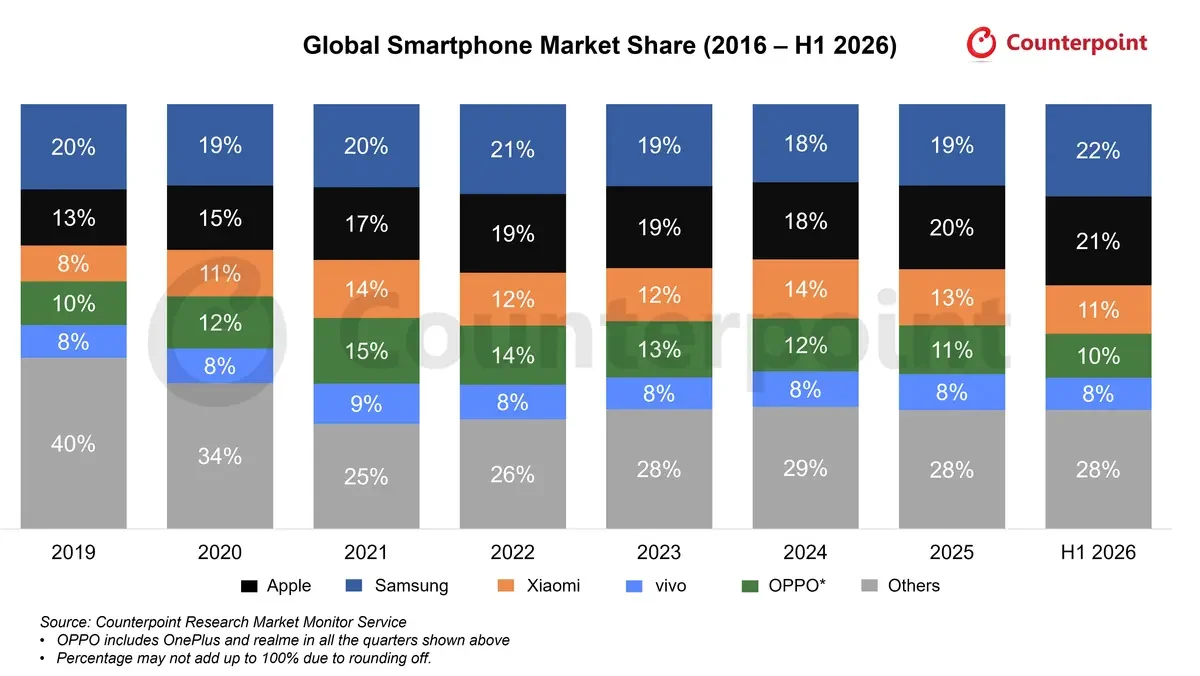
Counterpoint’s historical chart compares H1 2026 with full-year figures from prior years, so it is not a like-for-like annual comparison. Even so, it shows a clear shift in market concentration.
| Brand | 2019 | 2023 | 2025 | H1 2026 |
|---|---|---|---|---|
| Samsung | 20% | 19% | 19% | 22% |
| Apple | 13% | 19% | 20% | 21% |
| Xiaomi | 8% | 12% | 13% | 11% |
| OPPO* | 10% | 13% | 11% | 10% |
| vivo | 8% | 8% | 8% | 8% |
| Others | 40% | 28% | 28% | 28% |
*Counterpoint’s OPPO grouping also includes OnePlus and realme.
The “Others” category has fallen from 40% of shipments in 2019 to 28% in H1 2026. As a result, the five leading vendor groups accounted for about 72% of global shipments in the first half, compared with roughly 59% in 2019.
Samsung’s 22% is its highest figure in this chart, while Apple has made the larger long-term gain, rising from 13% in 2019 to 21%. Xiaomi slipped to 11% after reaching 14% in both 2021 and 2024, while OPPO declined from a 15% high in 2021 to 10%. vivo remained near 8%. With demand under pressure and components becoming more expensive, the next key question is whether Samsung and Apple can sustain their combined share as the remaining market narrows.