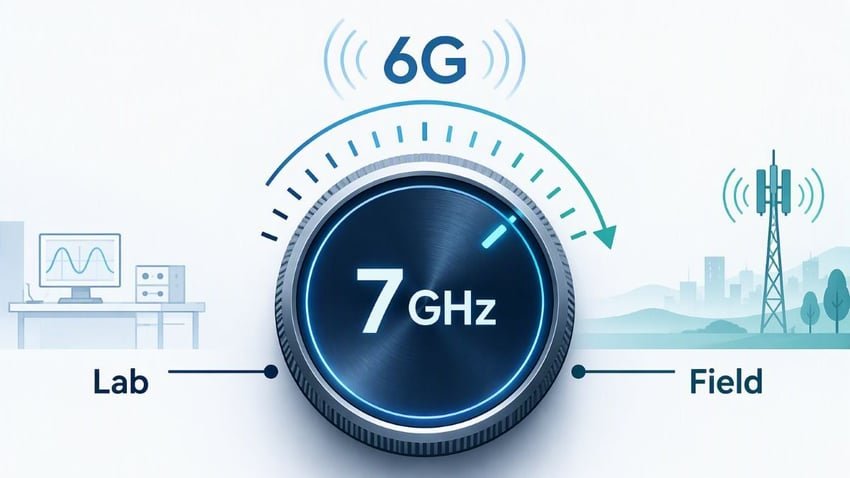
Verizon and Ericsson have completed an outdoor experimental 6G call using spectrum in the 7GHz band, taking an early research setup beyond a conventional lab environment. The demonstration took place at a Verizon site in a parking lot in Concord, California.
The setup was not a commercial 6G network. Ericsson deployed a proof-of-concept base station running experimental software, at a time when 6G specifications have yet to be finalized by standards bodies including 3GPP.
Engineers assessed coverage, data speeds, latency and connection stability, including how vegetation, obstacles, windows and building materials affect signal propagation. The officially confirmed call was made outdoors, but the trial also examined how the signal could reach indoor spaces.
For those indoor tests, the companies used a mobile laboratory measuring roughly 3.7 by 2.4 meters to simulate a home or office environment with connected devices. It was positioned 100 meters and 200 meters from the base station.
The 7GHz range is being considered as a potential option for future US 6G deployments. The National Telecommunications and Information Administration is examining several spectrum ranges, including:
- 7,125–7,400MHz
- 4.4GHz
- 2.7GHz
- 1.66GHz
Spectrum availability and the eventual 6G standard remain unresolved, and commercial 6G networks are generally expected to emerge around 2030. The Verizon-Ericsson field trial is an early data point in determining whether 7GHz can support that next-generation rollout.