
The US Federal Communications Commission conditionally approved SpaceX’s Starmind project on November 25, 2026, clearing the company to deploy as many as 1 million satellites for orbital AI data processing. The satellites would operate in layers between 500 and 1,002 kilometers above Earth, using solar power available nearly continuously in some orbits before sending processed results back to the ground.
SpaceX has positioned the concept as a way to shift some computing demand away from terrestrial power grids and the water-intensive cooling systems used by ground-based data centers. Company president Gwynne Shotwell has identified 2027 as the target for initial launches, but the FCC authorization imposes a far longer sequence of operational milestones.
- At least one satellite must be in its assigned orbit and operational by November 25, 2033.
- The constellation must reach 100,000 satellites by November 25, 2035.
- SpaceX must have 500,000 satellites in orbit by November 25, 2038.
- The full 1 million-satellite target is due by November 25, 2040.
Reaching the final target would require SpaceX to place nearly 685 satellites into orbit per day on average for two years. The authorization runs for 15 years from certification that the first satellite has entered service.
Computing scale and orbital constraints
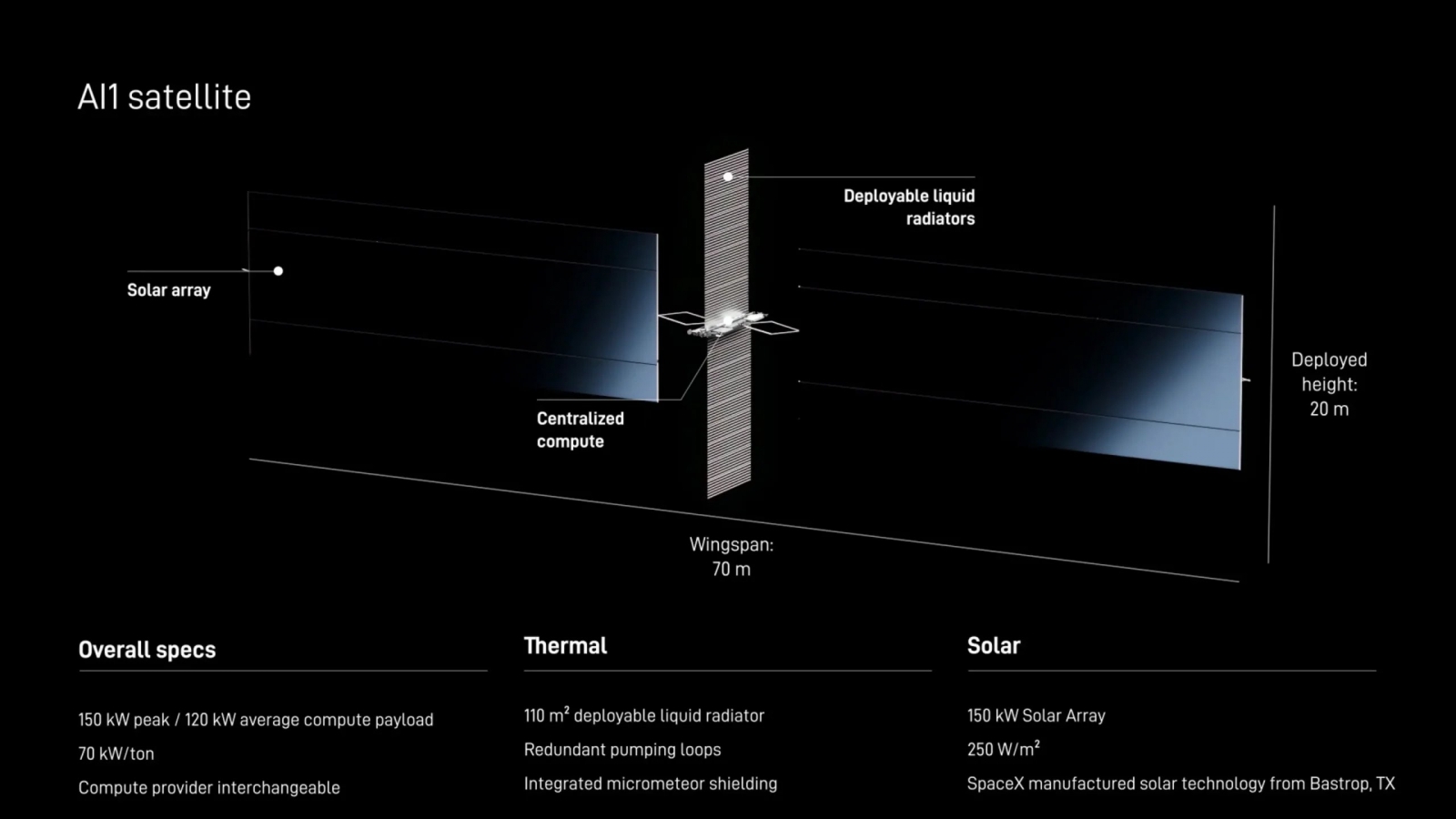
SpaceX has described an AI1 module with an average compute load of 175 kW and a peak load of 250 kW. If 1 million modules used that configuration continuously at the stated average load, their computing equipment would total 175 GW and consume roughly 1,530 TWh annually. That is a scale calculation based on SpaceX’s stated per-module configuration, rather than a confirmed forecast for the finished network. For context, the International Energy Agency estimates that all Earth-based data centers could use around 945 TWh in 2030.
Solar arrays could reduce reliance on ground power systems, but they would not remove the thermal challenge. Chips still generate heat, and in vacuum that heat must be expelled through radiators. The overall environmental impact would also depend on satellite manufacturing, launch activity, replacements and atmospheric reentries.

Starmind is expected to rely on laser links between satellites and connections to the Starlink network. The FCC has also authorized radio links for telemetry, tracking, emergency commands and maintaining control of spacecraft. Optical links to Earth can be disrupted by clouds, a limitation that has led NASA to use optical ground stations in multiple locations.
Orbital AI could be particularly suited to analyzing Earth-observation imagery in space and transmitting only alerts or other relevant results. Training large AI models across multiple satellites would be more difficult, requiring exceptionally fast and stable connections among accelerators that need to exchange data frequently. Google’s Project Suncatcher offers an early reference point: the company said it received a response from an AI model running on an orbital chip in October 2026, demonstrated 800 Gbps bidirectional throughput between two optical terminals in a lab, and plans to test two interconnected satellites in 2027.
The proposal also intensifies concerns over congestion in low Earth orbit. The European Space Agency has warned that collision fragments can trigger further collisions, while the American Astronomical Society says reflected sunlight and satellite heat can interfere with optical and infrared observations. The FCC has deferred a decision on SpaceX’s proposed alternative method for removing some satellites, leaving its requirement for reentry within five years of a mission’s end in force.