
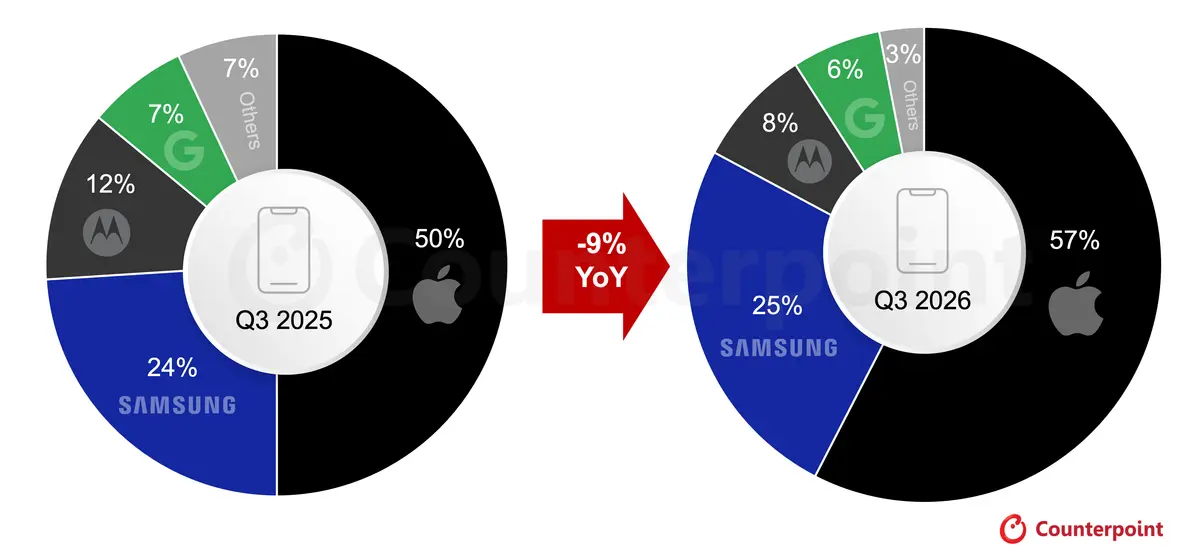
Apple captured 57% of US smartphone shipments in the third quarter of 2026 as the overall market contracted 9% year over year, according to Counterpoint Research. The iPhone maker was the only major vendor to avoid a shipment decline, while rising RAM and NAND costs weighed particularly heavily on Android brands with large affordable-device portfolios.
| Vendor | Q3 2025 share | Q3 2026 share | Year-over-year change |
|---|---|---|---|
| Apple | 50% | 57% | +7 percentage points |
| Samsung | 24% | 25% | +1 percentage point |
| Motorola | 12% | 8% | -4 percentage points |
| 7% | 6% | -1 percentage point | |
| Others | 7% | 3% | -4 percentage points |
The figures are rounded. When combined with the 9% market decline, they imply that Apple’s US shipments rose by roughly 4% year over year, while Samsung’s fell by about 5% and Motorola’s dropped by nearly 40%. Those are estimates derived from Counterpoint’s rounded shares rather than vendor-reported shipment totals.
Apple and Samsung together accounted for 82% of US shipments during the quarter, up from 74% a year earlier. Motorola’s four-point share loss amounts to roughly one-third of its prior position in the market, following a quarter in which it had posted annual shipment growth. Counterpoint links the reversal to component inflation that has weakened the competitiveness of lower-priced phones.
Samsung held up better through a mix of Galaxy S and Galaxy Z flagships alongside the more affordable Galaxy A line. Google’s share still slipped by one point year over year despite the launch of the Pixel 11 series.
A wider slowdown, with a delayed recovery
The US contraction was less severe than several other major markets in Q3. Counterpoint reported year-over-year shipment declines of 11% in China, 18% in Europe, 20% in India and 24% in Latin America; the global average decline was 19%. Apple and Samsung’s combined share also increased elsewhere, reaching 66% in Europe, 44% in Latin America and 43% globally.
Sales through the three largest US carriers declined 4% during the quarter. Counterpoint expects carriers to be more selective with holiday-period promotions, limiting one potential lever for a near-term market recovery.
- 2026: Global smartphone shipments are forecast to decline 14%.
- 2027: Global shipments are forecast to decline a further 6%.
- 2028: Global shipments are forecast to return to 6% growth.
Even a 2028 rebound would not fully restore the shipment volumes lost during the two-year downturn. The more immediate competitive question is whether memory-cost pressure will further reduce the number of viable low-margin smartphone options as Apple and Samsung consolidate their positions.