Worldwide smartphone shipments dropped 22% year over year to 255.3 million units in the third quarter of 2026, according to IDC, marking the steepest annual decline ever recorded in a single quarter. The market researcher does not expect a return to growth before 2028.
IDC attributes the downturn largely to a memory-component squeeze. Demand from AI infrastructure has driven memory-chip prices up by roughly 350% over one year, forcing phone makers to raise handset prices, revise hardware configurations and, in some cases, discontinue affordable models.
Samsung and Apple limited their losses far more effectively than the wider market, underscoring the relative resilience of premium smartphones.
| Company | Q3 2026 shipments | Year-over-year change | Market share |
|---|---|---|---|
| Samsung | 57.8 million | -5.8% | 22.6% |
| Apple | 57.3 million | -4.0% | 22.4% |
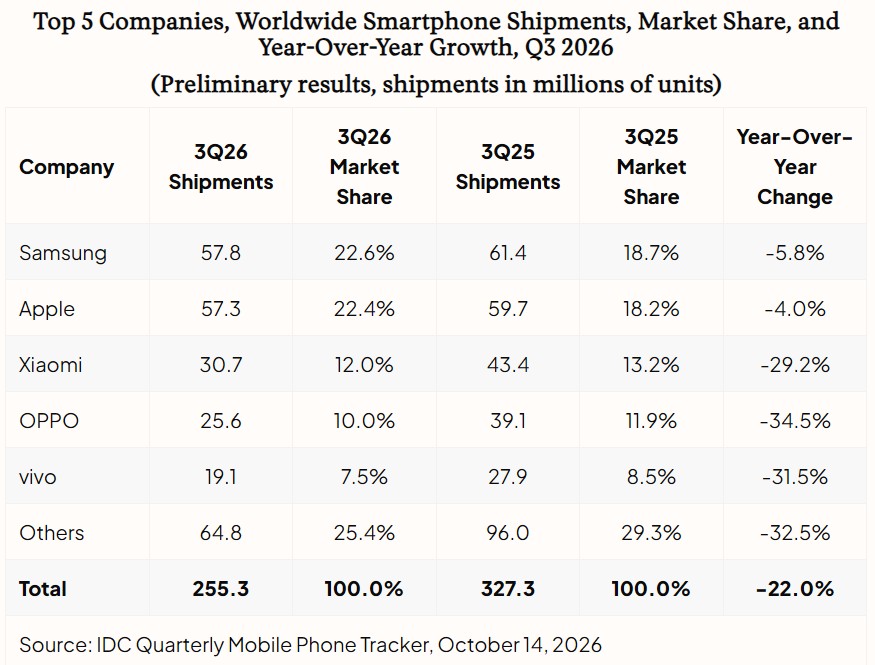
Several Chinese brands saw substantially sharper shipment declines during the quarter:
- Xiaomi shipped 30.7 million smartphones, down 29.2% year over year.
- OPPO shipped 25.6 million smartphones, down 34.5% year over year.
- vivo shipped 19.1 million smartphones, down 31.5% year over year.
The figures broadly align with Counterpoint Research’s estimate of a 20% global shipment decline for the same quarter. Both firms point to stronger performance at the premium end of the market, while mounting component costs could further constrain the availability of lower-priced phones before the sector reaches its expected bottom.