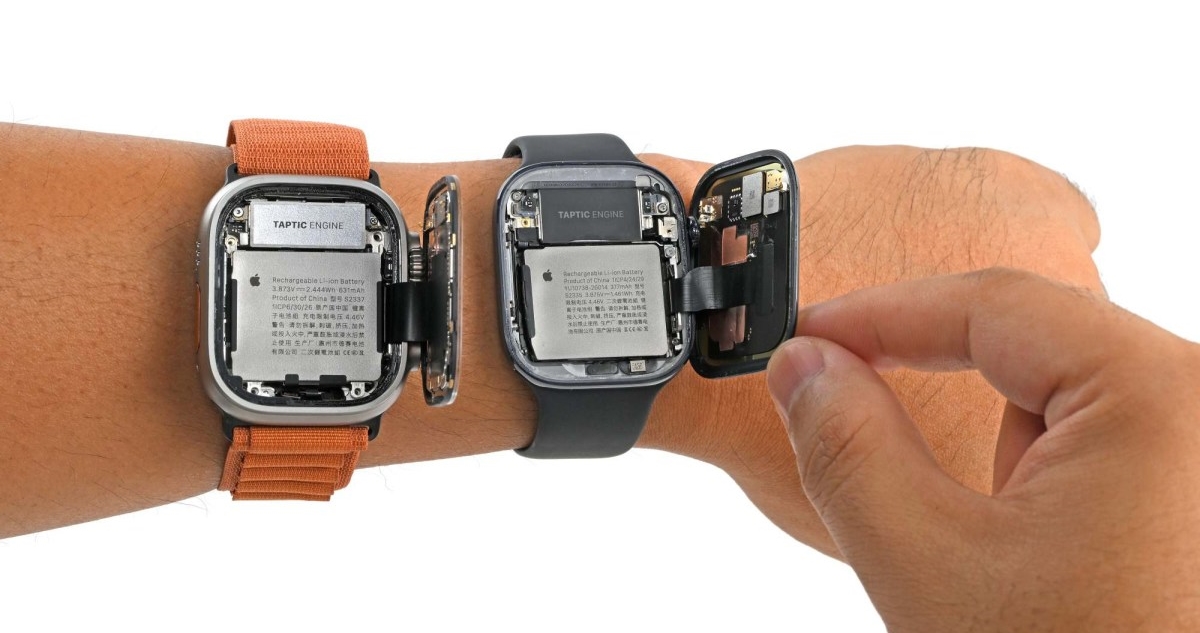
The Apple Watch Series 12 and Apple Watch Ultra 4 have each received a 4 out of 10 repairability score from iFixit, with the bonded display remaining the central obstacle to common repairs. Replacing a battery in either watch requires opening the display first, a process that risks damaging the panel before the battery is accessible.
The Series 12 gains one point over its predecessor. Apple has adopted stretch-release adhesive with a pull tab for the battery and replaced the display’s ZIF connector with a press connector that is easier to disconnect. Those changes only help after the watch has been opened, however: the narrow gap between the screen and case makes it difficult to insert opening tools, and a display replacement also requires removing the battery.
The Ultra 4 retains the same repairability score as the previous model. Its display adhesive must be heated and carefully separated to reach the battery, while the four rear screws provide access to the sensor assembly and S11 chip area rather than a direct route to the cell. The battery is rated at 2.444 Wh, up from 2.313 Wh in the Ultra 3—an increase of about 5.7%—but that capacity gain does not alter the opening process.
Once inside, battery removal and display disconnection are less complicated, but flexible cables can still be damaged during repair and the watch must be properly resealed afterward. iFixit also points to the lack of official Apple watch repair parts, tools and manuals, contrasting that situation with repair programs available for some of the company’s other products.
The result also leaves Apple well behind the Pixel Watch 5, which iFixit rated 9 out of 10. Google’s watch uses two Torx screws and a gasket for screen removal, while its battery does not require adhesive to be separated. Apple’s incremental Series 12 changes improve the service process only after the most failure-prone step—removing the display—has already been completed.
Affiliate link: Check availability on Amazon.de