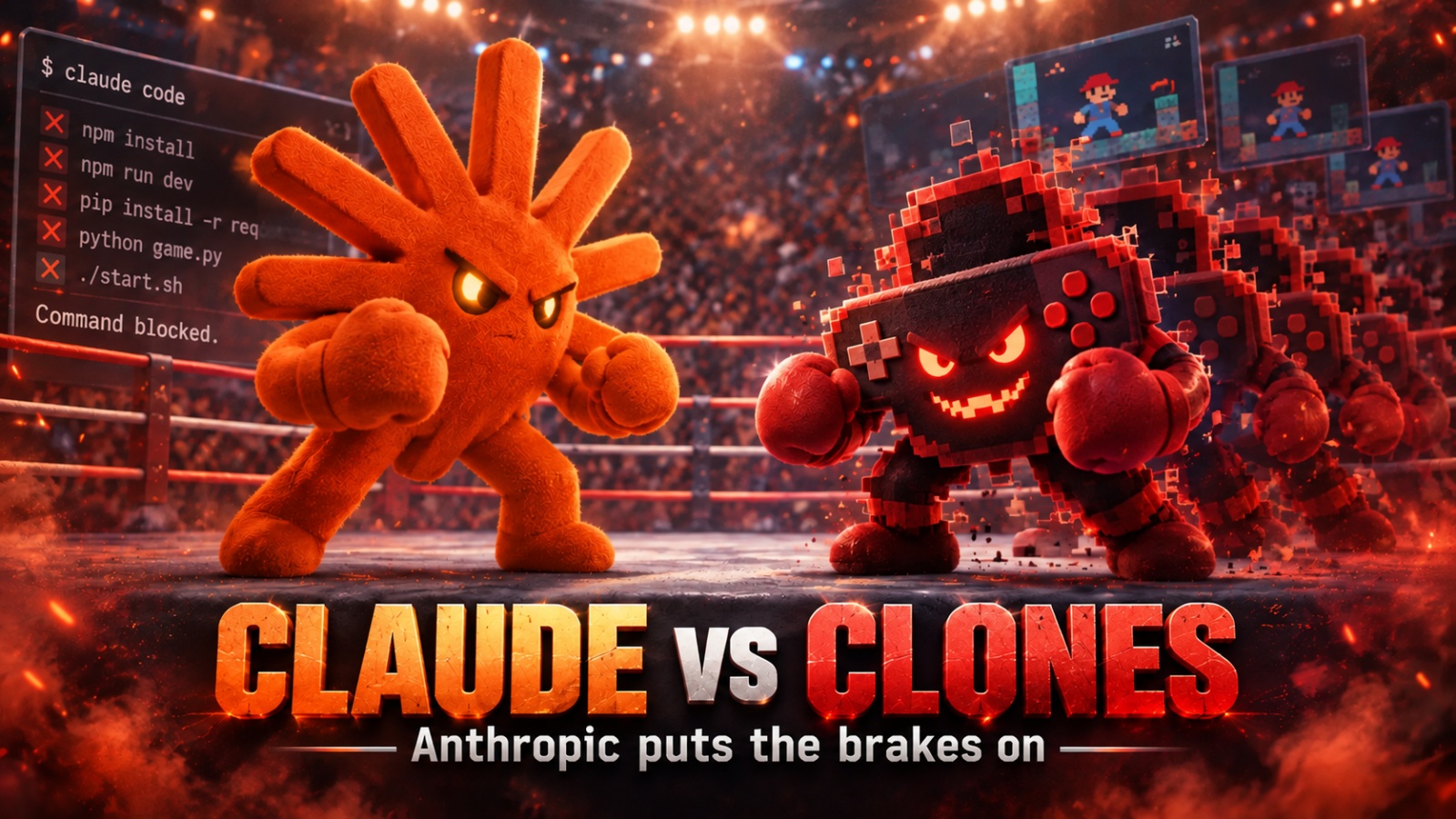
Anthropic has added a Claude Code restriction intended to stop the AI coding tool from recreating existing video games. The rule, which users identified in the tool’s configuration, also applies when a game is renamed or presented as an original project.
The restriction was reportedly introduced around October 27 and confirmed on October 30. Addy Osmani of Anthropic said the instruction was added for Claude Code using Opus 5.5 to discourage intellectual-property infringement. It does not prohibit game development altogether; instead, it is meant to distinguish between original work and reproducing a particular existing title.
A user known as Chasm found the server-delivered rule under the internal name tengu_heron_brook. According to that report, Claude Code users do not have a setting to disable it.
What the rule permits and restricts
- Permitted: Building a wholly original game from a user’s own ideas.
- Permitted: Creating a game based on a genre, such as a platformer, racing game, or RPG, with original concepts and visual assets.
- Restricted: Recreating a specific video game, even if its name is changed and the result is described as original.
The practical boundary may be difficult to enforce. AI coding tools have made it easier to generate and adapt software through so-called vibe coding, but the same accessibility can speed up the production of close copies. Anthropic will need to determine how reliably Claude can separate genre conventions, legitimate inspiration, modding, remakes, and cloning.
Studios are already concerned about AI-enabled copying
The concern is not purely theoretical for game developers. Digital Sun, the studio behind Moonlighter, postponed a public Steam playtest for its upcoming game ReVamp because of fears that someone could analyze the test build and release an AI-assisted clone ahead of the original.
The Spanish studio explained the decision on October 19 and switched to smaller Discord-based sessions beginning October 29. A wider test could take place in January 2027. For independent studios, early builds are important for feedback and audience building, but developers may increasingly see publicly distributed demos as a potential copying risk.
The new rule has also prompted complaints from users whose work is not necessarily a commercial game clone. A developer at Conflict Simulations LLC said on GitHub that the restriction blocked work on client-commissioned digital modules for tabletop strategy games. The developer later clarified that the projects were not licensed by the games’ publishers, were made for people who own copies and supply their own materials, and were not publicly distributed.
That case does not establish that Claude Code blocks work authorized by rights holders, but it illustrates the difficulty of applying a broad automated copyright safeguard to edge cases. Osmani said Anthropic will continue refining the rule and asked users whose original projects are refused to submit specific examples. For now, the policy applies to Claude Code with Opus 5.5, while other AI coding models may not use the same restriction.