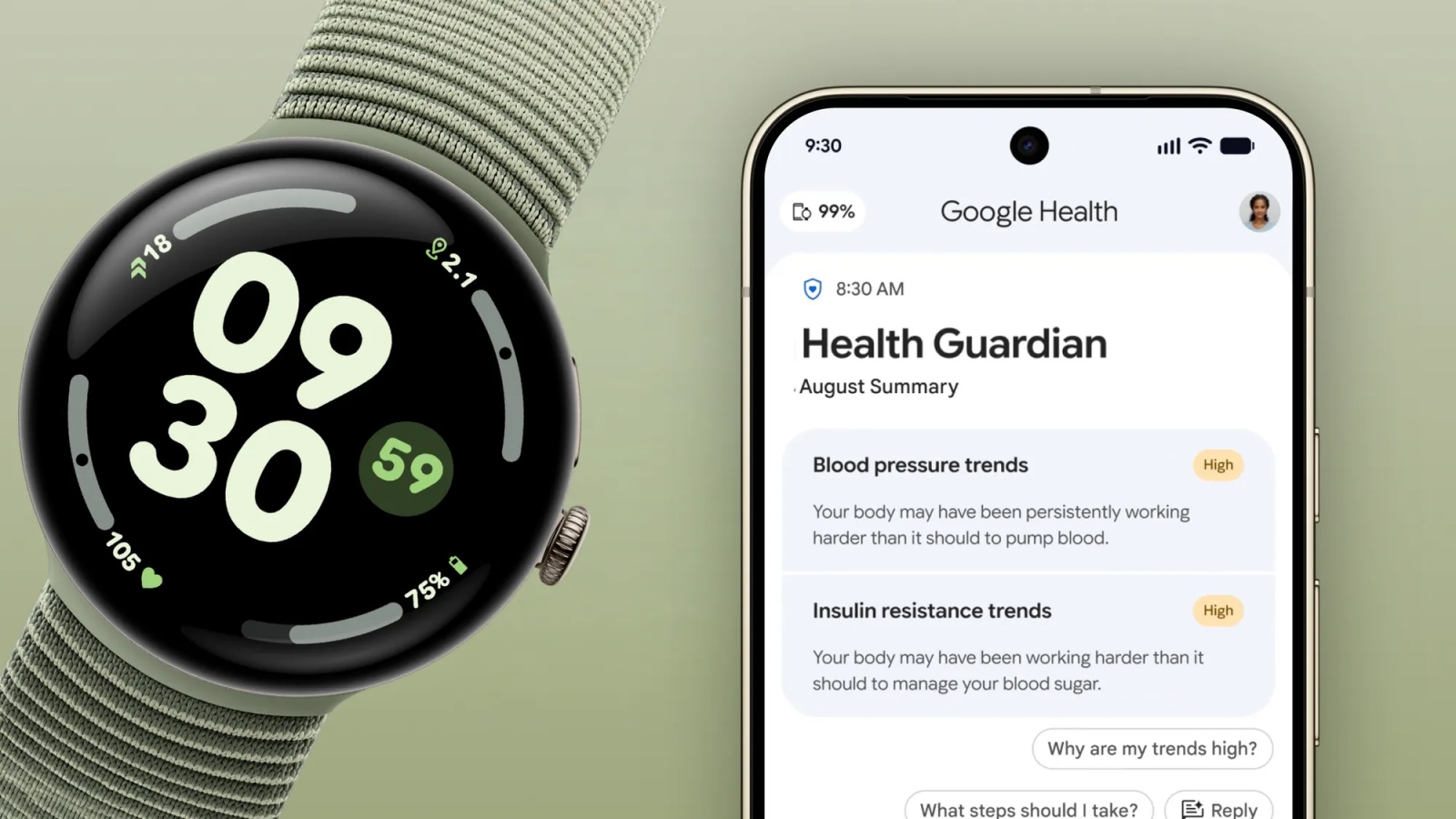
Google has begun rolling out its Health Guardian features to the Pixel Watch 3, Pixel Watch 4 and Pixel Watch 5. The software can identify longer-term patterns associated with high blood pressure and insulin resistance, but it does not turn the watches into blood-pressure monitors or glucose meters.
The package includes Blood Pressure Trends, Insulin Resistance Trends and Sleep Breathing Quality. Pixel Watch 4 and Pixel Watch 5 models also receive Breathing Emergency Detection in selected European countries. Google says the trend features require data collected over multiple days and produce periodic reports, since they are intended to identify changes over time rather than provide a single reading.
That distinction is central to the blood-pressure feature. Google uses models developed from large datasets of heart-rate and movement information, including WavesFM, to look for physiological shifts associated with blood-pressure concerns. The company says the approach has been evaluated in clinical studies, but it does not provide systolic or diastolic values on demand.
| Feature | Huawei Watch D3 | Pixel Watch with Health Guardian |
|---|---|---|
| Blood-pressure approach | Direct measurement | Tracks trends associated with blood pressure |
| Hardware | Inflatable cuff and mini-pump built into the strap | Existing watch sensors |
| Output | On-demand systolic and diastolic readings | Longer-term pattern analysis and alerts |
| Role | Wrist blood-pressure monitor | Early-warning system |
Google explicitly says Health Guardian information is not a diagnosis of hypertension or diabetes. The insulin-resistance feature does not use a glucose sensor or blood test; instead, it correlates other physiological signals to identify patterns that Google says may be linked to metabolic changes.
The rollout also extends functions initially introduced alongside the Pixel Watch 5 to older hardware. All three supported generations receive Blood Pressure Trends, Insulin Resistance Trends and Sleep Breathing Quality, reflecting Google's effort to draw more health insights from sensors already used for heart rate, HRV, SpO2, skin temperature, respiratory rate and sleep tracking.
Google plans to bring the blood-pressure and insulin-resistance trend analyses to Fitbit Air later in 2026. Those features will require a Google Health Premium subscription on Fitbit Air, while Google says they are included on compatible Pixel Watch models without an additional subscription.
The approach broadly mirrors the direction of hypertension notifications on Apple Watch: moving away from a one-time measurement and toward algorithms that can detect whether a user's baseline data is changing. The key remaining question is how broadly Google will make the new Health Guardian capabilities available across markets.