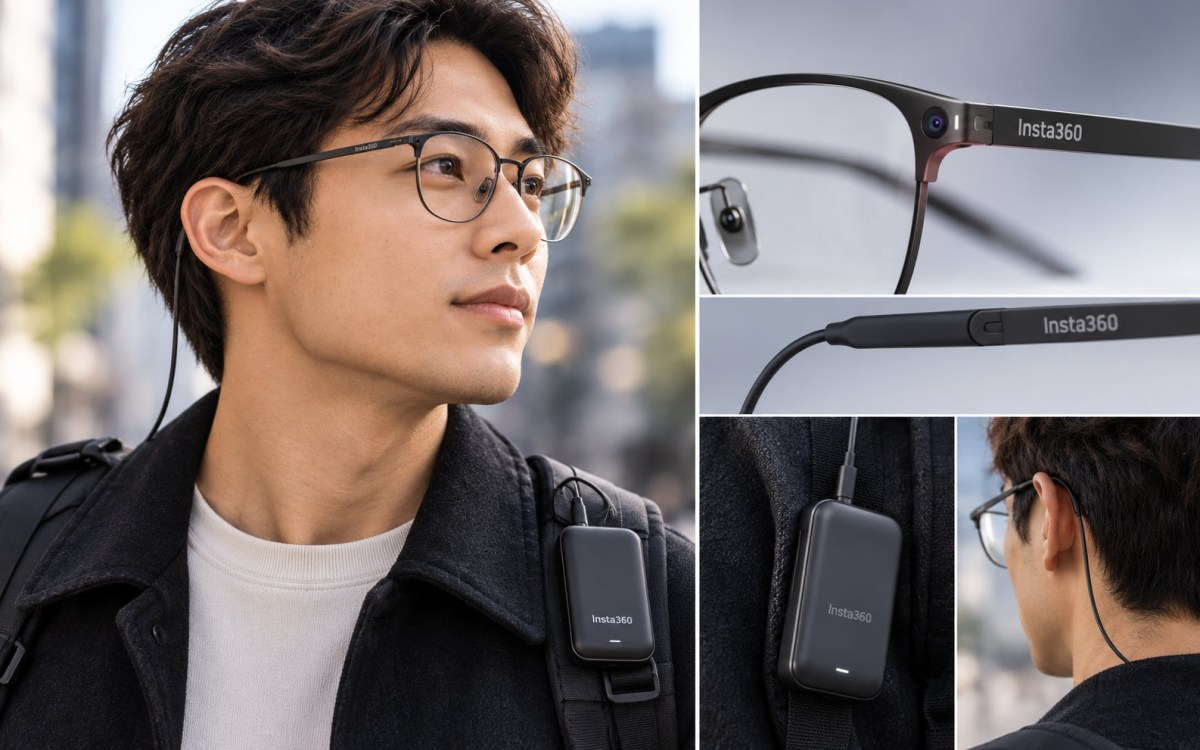
Insta360 has been linked to AI glasses that could shift the battery out of the frame and into a separately worn pack. A company patent, CN224328287U, describes glasses supplied by an external battery through a cable, with the stated aim of reducing the weight carried on the wearer’s head and improving long-term comfort.
The patent was filed in 2025 and granted in June 2026. Its focus is the power architecture rather than a full product specification: it does not establish a commercial name, launch schedule, price, camera configuration, battery capacity, or whether the external pack would be swappable.
Sina Technology, citing sources close to the company, reports that Insta360 is developing AI glasses. Insta360 itself has not announced such a device, so the reported product and the patented design should not yet be treated as a confirmed retail launch.
Moving the battery off the face addresses a central hardware constraint for smart glasses. Frames may need to accommodate processing hardware, microphones, speakers, connectivity components and potentially cameras, while remaining light enough for extended wear. An external battery could lower frame weight and potentially allow a larger power reserve, although the patent does not make an endurance claim.
A potential fit with Insta360’s camera business
The report does not confirm that Insta360’s glasses would include a camera. Still, the category would align with the company’s work in hands-free and point-of-view capture. Its 50-gram Insta360 GO Ultra is built for body-worn recording, while the wider GO range targets quick capture without needing to take out a phone or conventional camera.
Insta360 has also expanded beyond its original 360-degree cameras, including the Luna Ultra dual-camera vlogging device with a gimbal and Leica optics, alongside a growing range of creator-focused cameras and accessories.
The company would enter an increasingly crowded smart-glasses market. Meta already sells products in the segment, Google is advancing Android XR, Samsung has confirmed smart glasses for 2026, and Acer has shown its AR Vision GR0 and GI0 concepts. For Insta360, the unanswered question is whether the cable-and-pack approach can deliver a meaningful comfort advantage without creating a new inconvenience for users.