
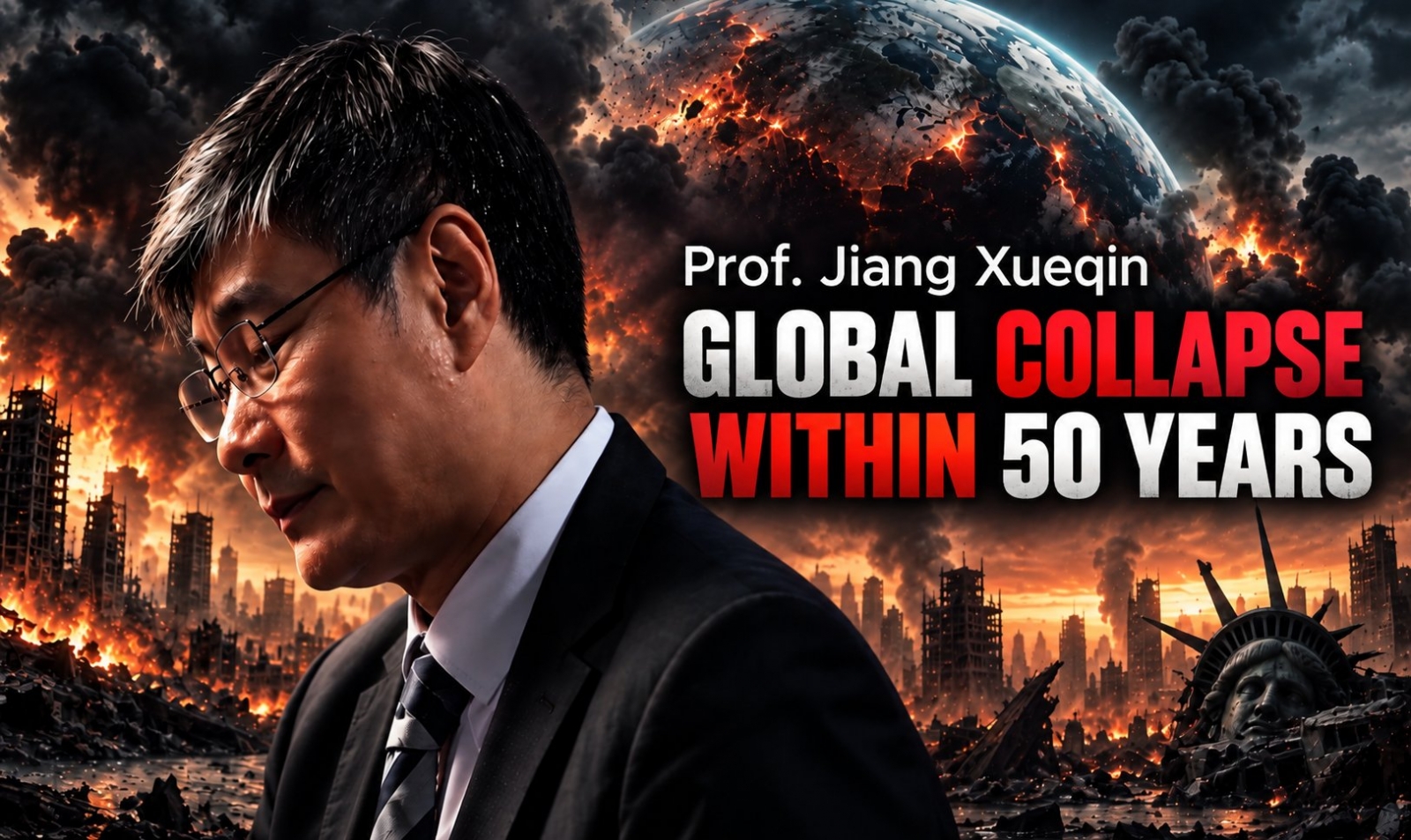
Jiang Xueqin, the Chinese-Canadian educator and online commentator known as “Professor Jiang,” says human society could face systemic collapse within the next 50 years as geopolitical conflict, economic interdependence and expanding technological control converge.
In a widely circulated podcast excerpt, Jiang argues that conventional state power could be displaced by technology corporations and influential industry figures operating what he calls “network states.” He points to artificial intelligence, robotics and smart surveillance as systems that could concentrate political and economic control in fewer hands.
His framework compares today’s globally connected economy with the Bronze Age world, when trade in bronze linked distant societies. Jiang cites the collapse around the end of that era, followed by the Greek Dark Ages, as an example of how economic breakdown, internal unrest, war and environmental disruption can reinforce one another.
The key difference, he argues, is modern interdependence. A major power suffering a severe collapse would not necessarily be replaced by a rival; instead, connected financial, trade and technology systems could transmit the damage internationally. Jiang’s more severe predictions include a loss of purchasing power and widespread impoverishment, but these are forecasts rather than established outcomes.
Jiang has drawn attention online for political predictions that supporters say anticipated Donald Trump’s 2024 election win and the possibility of direct US-Iran confrontation. The same record also includes predictions that did not materialize, including a claim that Trump would choose Nikki Haley as vice president. Such mixed results underline the limits of using historical patterns to make precise geopolitical forecasts.
His “Predictive History” lectures combine history, geopolitics and game theory, with inspiration from Isaac Asimov’s fictional concept of psychohistory. Jiang graduated from Yale College in 1999 and has worked in education in China, including at Shenzhen Middle School, Peking University High School and Moonshot Academy in Beijing. His online “Professor Jiang” label should not be taken to mean that he holds a conventional university professorship.
For technology readers, the more immediate question is not whether a 50-year collapse prediction proves accurate, but how rapidly AI systems, automation and surveillance infrastructure are reshaping the balance between governments, corporations and citizens. Jiang’s scenario remains speculative, while the scale and governance of those technologies are already active global policy issues.