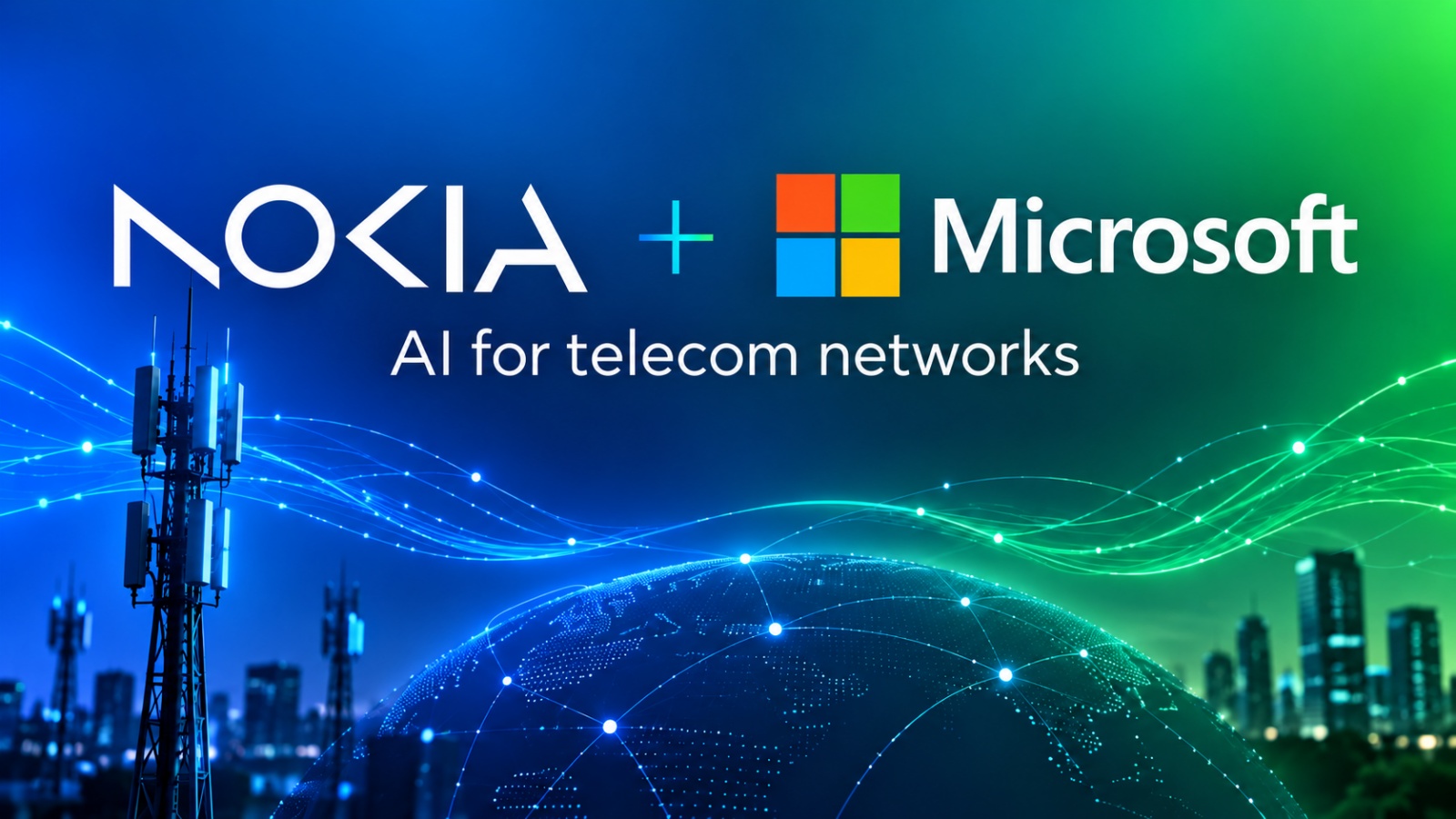
Nokia and Microsoft have expanded their partnership by integrating Nokia Data Suite with Microsoft Fabric, creating a shared data foundation intended to speed up telecom analytics and AI-led network automation. Nokia says network data that can take weeks to prepare could become usable within minutes through the combined platform.
The integration targets a central challenge for operators: network information is typically scattered across radio and core networks, IT systems, subscriber databases, cloud services and equipment from multiple vendors. Nokia Data Suite supplies telecom-ready data products, network-specific semantic models and quality controls, while Fabric contributes OneLake, analytics, governance and connections to Microsoft AI services.
| Component | Role in the combined platform | Key capabilities |
|---|---|---|
| Nokia Data Suite | Prepares and standardizes telecom data | Reusable data products, network semantic models and data-quality controls |
| Microsoft Fabric | Provides the unified data and analytics layer | OneLake, analytics, governance and integration with Foundry, Copilot and Power BI |
| Combined platform | Brings together varied operator data sources | Support for multivendor network, cloud, on-premises and external IT data |
Nokia says its reusable data products can reduce MLOps work by up to 70% by removing repetitive data-preparation tasks. Microsoft had previously said its Fabric integration could cut development time for telecom AI use cases by as much as 80%. Those are company-stated targets rather than independently verified deployment results.
Initial automation use cases
The companies have identified early workloads where agents can work across network, service and subscriber data rather than a single operational dashboard.
- VoNR assurance: AI agents can identify anomalies in Voice over New Radio calls, investigate likely causes and recommend actions using network, service and subscriber information.
- Geo-experience analysis: operators can correlate user sessions with geographical and radio data to identify weak-signal areas, congestion and locations with insufficient capacity.
Nokia also points to automated root-cause analysis and eventual closed-loop operations, in which automation can act after a fault is identified. The platform is designed for hybrid and on-premises deployments as well as cloud environments, a key consideration for operators that cannot move all network data into a public cloud.
The agreement fits Nokia's wider push into AI-RAN and 6G. The company has committed $1 billion and formed a partnership with NVIDIA around that effort, while saying operators in several regions are testing AI-RAN on NVIDIA platforms. Nokia has claimed more than 20% improvements in spectral efficiency in its testing.
Nokia shares rose 6.3% in European trading after the Microsoft announcement, reaching €9.39 during the September 17 session, according to the WSJ. The joint product is already available, and the companies say they plan to add further automation scenarios and operator deployments; the key test will be how extensively operators allow AI agents to move from analysis into day-to-day network actions.