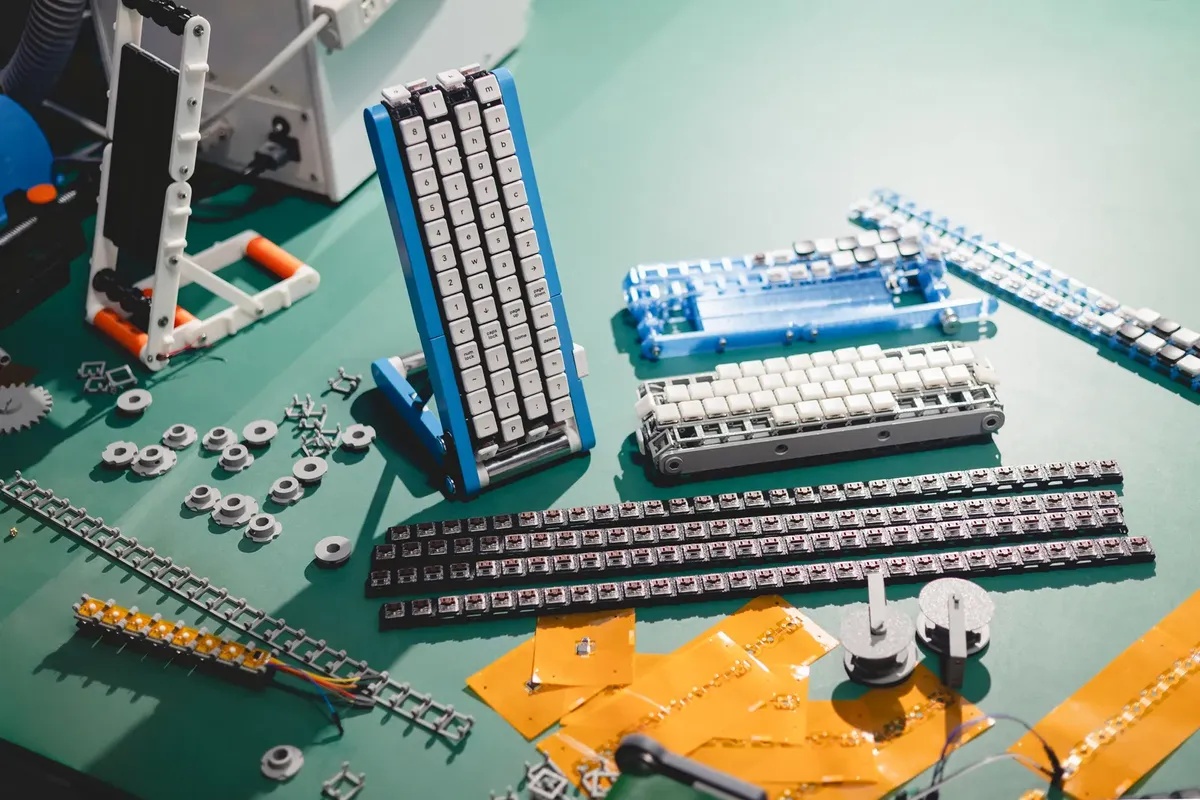
Google Japan has unveiled the Gboard Conveyor Belt Version, an experimental 116-key keyboard designed to bring each character to the user rather than requiring the user to move across a conventional key layout. The project is not a commercial product, but Google has released the files needed for ambitious builders to reproduce it.
The keyboard places its keys on four continuously rotating conveyor belts. Each belt carries 29 keys, and the user keeps a hand—or potentially one finger—in a fixed position, pressing the desired key as it passes by.
Uppercase and lowercase characters receive separate keys, reducing the need for Shift when typing letters. Google also suggests that two units could be positioned side by side for two-handed input, while a single unit leaves the other hand free for another task.
Open-source build, incomplete Bluetooth version
Google has published 3D-printing models, firmware and mechanical documentation for the project through its open-source repository. The available materials cover two proposed versions:
- Moving Keys Edition: the physical conveyor-belt keyboard with rotating keys.
- Bluetooth Connection Edition: a version intended to operate as a full Bluetooth keyboard.
For now, the documentation focuses primarily on the mechanical Moving Keys Edition. Electronics information for the Bluetooth Connection Edition is marked “Coming soon,” so the wireless version is not yet fully documented.
The Conveyor Belt Version is the 15th entry in Google Japan’s long-running series of unconventional Gboard keyboard concepts, which began in 2010. Previous experiments have included single-row, head-worn, double-sided and rotary-dial keyboard designs; the latter arrived as the Gboard Dial Version last year.
While the moving-key approach could theoretically reduce the hand travel required to reach commands, Google is not presenting it as a medical or accessibility device. Its practical status remains that of an open-source engineering experiment, with the Bluetooth implementation the main unfinished piece.