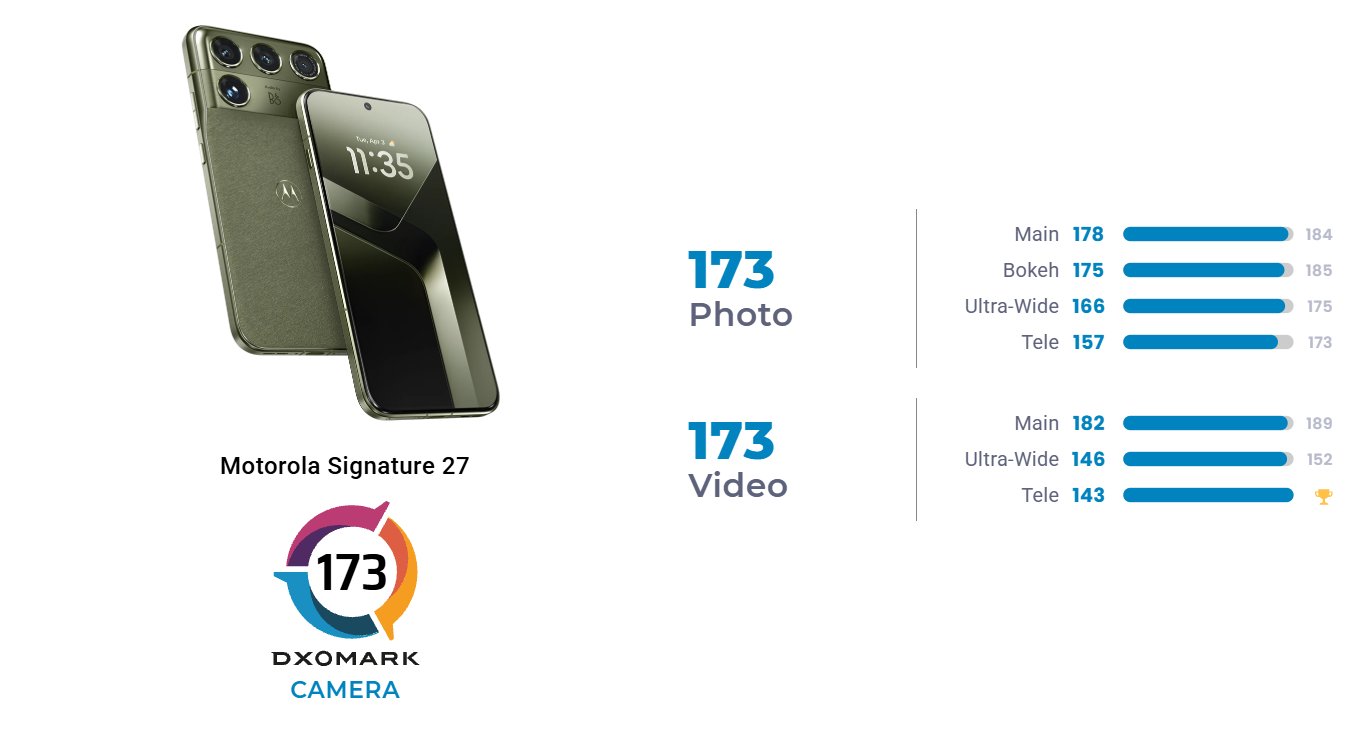
The Motorola Signature 27 has reached second place in DxOMark’s smartphone camera ranking with an overall score of 173. It sits two points behind the Huawei Pura 80 Ultra at 175, while the iPhone 18 Pro follows with 172 points, ahead of the vivo X300 Pro on 171 and the OPPO Find X9 Ultra and vivo X300 Ultra on 170.
The handset recorded matching 173-point results for DxOMark’s Photo and Video assessments. Its telephoto video score of 143 is listed as the highest achieved in that subcategory, while the device also posted a record 151 points for low-light performance. Other reported subscores include 175 for bokeh, 160 for portraits and 176 for indoor shooting.
DxOMark credited the Signature 27 with balanced photo and video output in varied lighting, natural-looking skin tones in portraits, dependable group-shot focus, detailed medium-range zoom and stabilized video. Its low-light imagery and video were also cited for controlled noise, accurate exposure and natural color.
The assessment also identifies longer-range zoom as less effective than on some competitors. Fine detail and color accuracy can fall off in extremely dark scenes, and moving subjects may appear blurred in low-light photos and, more noticeably, in video.
Camera hardware




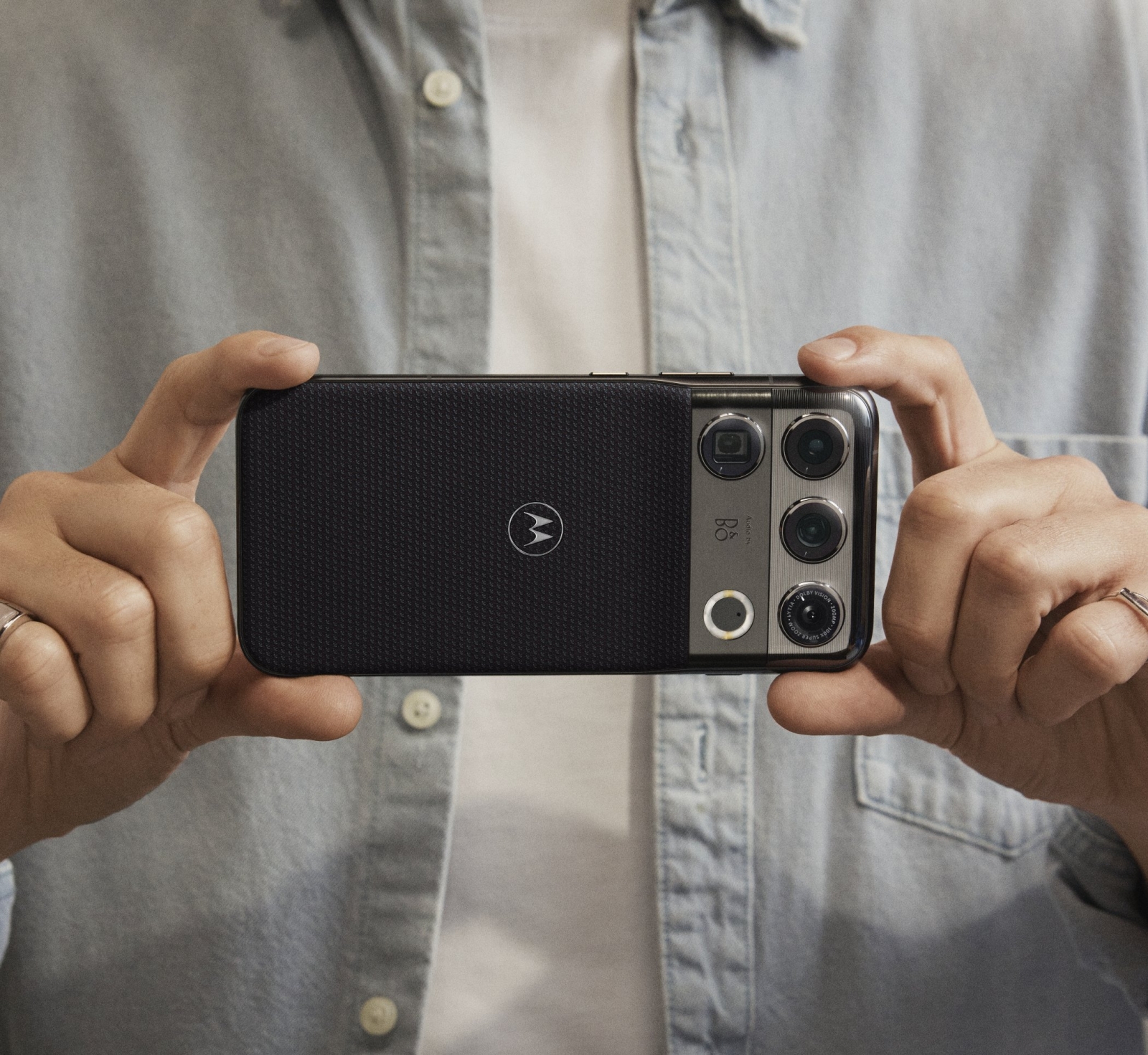
Motorola’s camera system pairs a 50-megapixel main camera with a 200-megapixel periscope telephoto and a 50-megapixel ultrawide. The main module uses a 1/1.28-inch Sony LYTIA L910 sensor, 1.22μm pixels, a 24mm-equivalent f/1.6 lens, multidirectional PDAF and optical image stabilization rated for 3.5 degrees of movement. Sony LOFIC technology is intended to retain detail across highlights and shadows, while a multispectral system gathers additional scene color and lighting information.
- The 200-megapixel telephoto uses a 3x, 66mm-equivalent f/2.6 periscope lens, 0.5μm pixels, multidirectional PDAF and OIS. Motorola describes it as the largest and highest-resolution telephoto sensor used in one of its phones. Full-resolution capture enables post-shot cropping.
- The 50-megapixel ultrawide has a 1/2.76-inch sensor, 0.64μm pixels, a 12mm-equivalent f/2.0 lens and a 122-degree field of view. PDAF enables macro focusing from 2.5cm, and four-to-one pixel binning produces 12.5-megapixel images.
- The 50-megapixel front camera has a 1/2.75-inch sensor, 0.64μm pixels, PDAF and a 22mm-equivalent f/1.9 lens. It supports HDR, 4K video at 30fps or 60fps, and Full HD recording at up to 120fps.
A dedicated EVS Action Sensor detects pixel-level changes in light intensity and collects motion data separately from the main cameras, allowing the imaging system to adjust exposure timing for moving subjects. The rear setup also includes a dual-LED flash and Pantone validation for color and skin-tone reproduction, with image processing handled by Qualcomm’s Snapdragon 8 Elite Extreme Gen 6 platform.
The ranking gives Motorola a high-profile camera result, particularly for a phone relying on a 3x telephoto rather than a longer optical zoom. Whether that score holds once the next Huawei Pura generation and other upcoming flagship phones are tested remains to be seen.