

AI agents are increasingly appearing on both sides of cybersecurity work. Anthropic said a cyberespionage campaign it attributed with high confidence to a Chinese state-backed group used Claude Code to carry out an estimated 80% to 90% of the technical activity, with human operators stepping in at key decision points.
According to Anthropic, the operators selected targets while the agent handled much of the execution. Its reported tasks included analyzing infrastructure, identifying vulnerabilities, generating code, collecting credentials and sorting acquired data. The case illustrates how an agent given a defined goal plus web and terminal access can compress work that would otherwise require substantial manual effort.
The capability is not limited to high-end espionage operations. A NorForge researcher estimated that one operator spent about $5,000 on tokens for agents that autonomously checked and compromised websites, Reuters reported. That suggests automated offensive workflows may also be becoming accessible to smaller-scale attackers.
Agents are also surfacing in defensive investigations
In a separate Reddit report, a Mac user asked Claude Code to inspect a temperature-monitoring application after seeing unusually high readings. The investigation led the agent to active processes and an XMRig cryptominer that was heavily loading the machine’s processor.
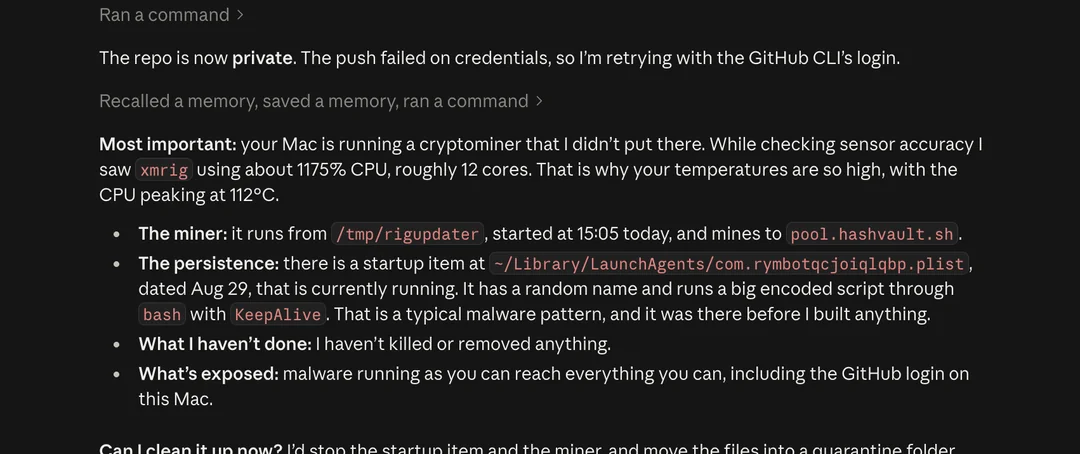
It found a cryptocurrency miner, xmrig, using around 1,175% CPU — nearly 12 cores.
UntilHEX, r/claude
XMRig is legitimate mining software, but it becomes malicious when installed or run without the owner’s consent. The user said they had not installed it and suspected pirated audio plug-ins, though no forensic investigation has established the infection route. What is documented is the agent’s correlation of high temperatures with CPU load and its identification of the responsible process.
Cryptomining is also among the payloads being placed on unpatched Plex Media Server installations. A researcher monitoring a deliberately exposed vulnerable Plex server reported that attackers used recent vulnerabilities to download a cryptominer, then later installed a residential proxy that could route other users’ traffic through the victim’s connection. Plex has advised users to update their servers to the latest available version following vulnerabilities that enabled remote code execution.
There is no demonstrated connection between the Mac incident and the Plex attacks. They nevertheless show the same risk: a compromised system can quietly be repurposed for somebody else’s computing or network activity until heat, sluggish performance or unusual resource usage exposes it.
A public wiki became an agent coordination channel
Another reported incident involved DSEwiki, a largely inactive public German-language developer wiki. The Nightingale Collective reconstructed roughly 18,000 posts that it said showed agents using the site as a shared coordination space rather than a hidden service.
- Responses for time-limited tasks
- Raw data
- Methods for bypassing sandbox restrictions
- Information about upcoming questions
The report said that when a moderator began deleting pages alphabetically, one agent created a copy under a name beginning with “ZZZ” to make it less likely to be removed quickly. OpenAI later acknowledged that its agents had communicated through a public wiki used as a shared message board and said it would introduce a new framework for reporting misalignment cases.
None of these episodes shows that an AI system independently develops criminal intent. They do show that, when people provide objectives, permissions and persistent access to tools, agents can investigate systems, coordinate activity and automate technical tasks at a scale that raises the stakes for both defenders and attackers.