Apple’s first foldable iPhone is making its strongest early case through its display and software behavior. Initial hands-on videos show the iPhone Duo shifting smoothly between its outer and inner screens, while the inner panel’s crease appears far less noticeable in normal use than it does under angled lighting.
The crease has not been eliminated, according to several early reviewers, but Apple’s matte, nano-textured inner display treatment appears to reduce the reflections that make it stand out. Brian Tong found that the fold takes a particular viewing angle to spot, while UrAvgConsumer said it can effectively disappear against bright on-screen content. BooredAtWork also noted that the crease remains detectable from the side, though it is not especially pronounced to the touch.
That visual treatment may be one of Duo’s more consequential hardware decisions. The physical reality of a folding OLED remains, but suppressing glare makes the center of the display less distracting when apps, video and games are on screen.
iOS 27 is also central to the early impression. Apps appear to expand rather than abruptly jump as the phone opens, and games reportedly adapt in the same way. Netflix can place video on the upper half with controls below, while Messages and Photos can run side by side, including drag-and-drop support for photos between apps.
The interface is not drawing universal praise. One early reaction questioned the amount of room occupied by the sidebar and whether it can be repositioned, while another found the right-side placement more natural for thumb access. Those differing responses suggest Apple still has usability details to prove across the Duo’s various folded and unfolded positions.
There are clearer compromises in the hardware. The under-display FaceTime camera is nearly hidden beneath the inner panel when inactive, but its location becomes visible when it is operating. An early camera sample was described as soft and noticeably sharpened, though usable.
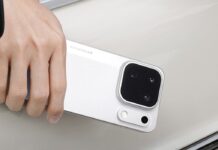
Apple has also opted for Touch ID in the side button instead of Face ID. That decision could be more conspicuous on a device intended to be used in multiple orientations. On the rear, the Duo has two cameras, with its 2x zoom produced from the main sensor rather than a dedicated telephoto lens.
The iPhone Duo starts at $1,999 for 256GB. Early hands-ons cannot settle whether the foldable hardware, display finish and iOS 27 changes justify that price, but they indicate that Apple’s approach is more than a larger iPhone screen. Longer-term testing beginning in October will have to determine whether the authentication and camera concessions outweigh its polished folding experience.