
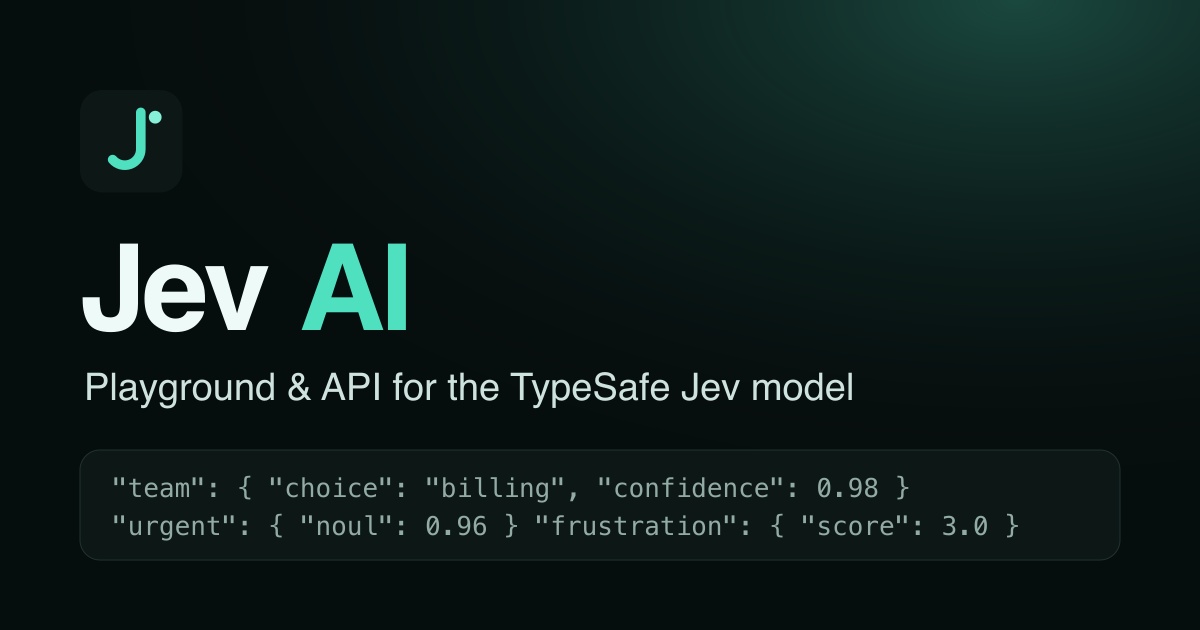
TypeSafe AI has launched Jev, a model built to make fast, structured decisions inside software rather than produce conversational text. In its first 24 hours on Vercel AI Gateway, nearly 13% of the platform’s paying teams tried it, according to Vercel—more than twice the uptake of any other recent model launch it tracked. That is a result from one platform, not evidence of broad market adoption, but it signals immediate developer interest in a different role for AI.
Jev is intended for tasks such as selecting the next tool for an agent, routing a prompt to a cheaper or more capable model, estimating whether an operation is risky, or deciding when a workflow should be escalated to a person. Instead of generating an explanation, it returns an output a program can consume directly from a predefined set of possibilities.
A model for bounded decisions
Developers provide the relevant context and define the acceptable response type in advance. TypeSafe describes three core output modes: a choice among fixed options, a score, or a probability from 0 to 1.
- Choice: select one option from a predefined set, such as “camera,” “gaming,” or “battery life.”
- Score: rate an input on a specified scale.
- Probability: estimate the likelihood of an outcome, such as whether an action presents a risk.
Conventional large language models can perform similar classification tasks, but they still generate tokens sequentially and need prompting or output constraints to conform to an application’s required structure. Vercel’s suggested division of labor is more narrow: conventional code handles exact rules, Jev handles judgment calls among defined options, and generative models remain suited to open-ended reasoning and text generation.
TypeSafe says Jev responds in roughly 70 to 500 ms and costs $42 per billion input tokens, with no charge for output tokens. The company reports results of up to 193.6 times faster and 444.6 times cheaper than certain LLM-based alternatives in its own workflows. Those are vendor-produced figures, and TypeSafe says they represent the upper end of the advantage that may be seen in real-world deployments.
One early experiment connected Jev to a multi-agent application. Given a recipe-video transcript, the model selected a web-extraction agent in 145 ms; when the transcript already included ingredients and steps, it selected a recipe-focused agent in 271 ms. The examples are not a benchmark, but they illustrate the dispatcher role developers are testing.
LangChain is also evaluating Jev for model routing, where a system directs simple work to a lower-cost model and difficult work to a more capable one, as well as for filtering potentially risky agent actions before they execute. That positioning makes Jev complementary to LLMs rather than a replacement for them.
Constrained output is not guaranteed accuracy
TypeSafe uses the phrase “Zero Hallucinations” in describing Jev, but the claim is about output constraints rather than infallibility. If an application permits only “Samsung,” “Apple,” or “Google” as answers, the model cannot return an unapproved category or a paragraph of prose instead of the expected value. It can still choose the wrong answer among the approved options.
That distinction matters in automated systems. A probability estimate can help an application determine whether to continue automatically, ask for human review, or decline an action entirely, but the confidence threshold must be designed by the developer. Armin Ronacher, creator of Flask and Jinja and now CTO at Earendil, has pointed to that problem in the context of model routing: a 50% result provides little more guidance than a coin toss, while a 95% result may be sufficient for a particular workflow.
The early reception has also brought skepticism. Some developers characterize Jev as a very fast general classifier rather than a fundamentally new model category, and question its advantage over small models, conventional rules, or dedicated classifiers. A researcher has separately said that a similar approach was published in 2025, while criticizing TypeSafe for not yet releasing a technical paper, model weights, or training data.
TypeSafe says it spent two years in stealth developing a proprietary architecture, a parallel sampling mechanism, and a training method it calls Reinforcement Learning for Calibrated Decisions, or RLCD. The company has not published full technical details, leaving the novelty of the underlying approach unresolved even as developers can test the product itself.
TypeSafe was co-founded by CEO Diogo Almeida, who previously worked at OpenAI and Google Brain and is presented by the company as a researcher involved with RLHF and InstructGPT work. Its other co-founders are former Meta/FAIR researcher Sasha Sheng and AI production-systems specialist Erik Gafni.
For now, Jev’s commercial and technical case rests largely on company benchmarks and fast-moving community experiments. Its most consequential test will be whether teams find enough high-volume, bounded decisions where a probabilistic model is genuinely more useful than conventional code—and cheap enough to run between every step of an agent workflow.