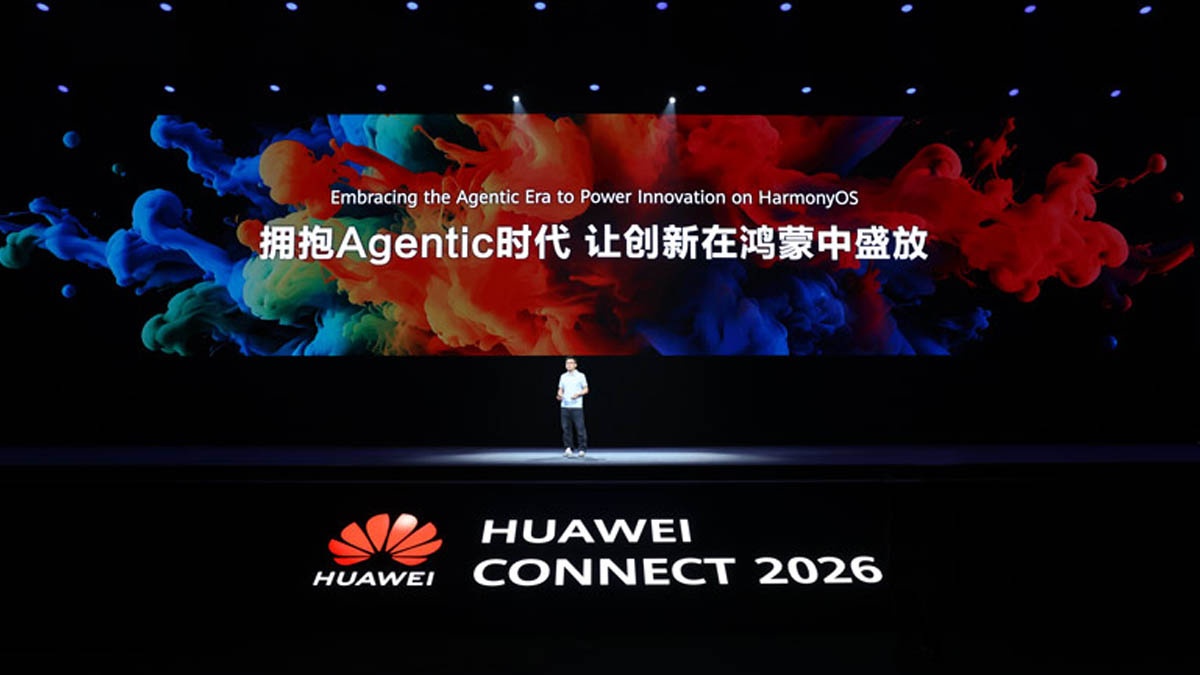
Huawei has outlined how HarmonyOS 7 is intended to evolve from a conventional mobile operating system into a platform for AI agents. At Huawei Connect 2026, the company said its HarmonyOS Agent Framework 2.0 will let apps, system features, Skills and third-party agents work through a common layer to complete multi-step requests based on user intent.
The approach, which Huawei calls “intent as a service,” shifts the task from finding individual services to stating a desired outcome and having the system assemble the required steps. Huawei says hybrid planning across the device and cloud achieves a success rate above 90% for complex tasks, though that figure is company-provided.
Celia is central to that plan. Huawei says the assistant can now access the following resources in HarmonyOS 7:
- More than 2,100 system functions
- More than 500 partner Skills
- About 2,000 other HarmonyOS agents
That scope is meant to reduce the need for users to dictate each action in sequence. Instead, Huawei’s model is designed to let Celia and connected agents plan a route across supported apps and services, with the eventual result rather than each intermediate command serving as the starting point.
Developer tools and cross-device tasks
Huawei is also opening more than 20 system-level AI capabilities to developers. Apps can connect to the shared planning mechanism through Skills and A2A, short for Agent to Agent. DevEco Studio is gaining AI-assisted development tools including DevEco Code and DevEco CLI, along with so-called vibe coding functions.
Other additions include on-device 3D reconstruction based on 3D Gaussian Splatting. Using the Ark graphics engine and NPU acceleration, Huawei says an object can be reconstructed in roughly three to five minutes. Galaxy Interconnect is also being extended to support tasks that move between devices, allowing an agent to continue an action elsewhere in the ecosystem.
Huawei presented the agent architecture against a growing HarmonyOS base. The company reports:
- More than 85 million devices running HarmonyOS 6 or HarmonyOS 7
- More than 11 million registered developers
- More than 400,000 available apps and services
- More than 1.3 billion OpenHarmony deployments in industrial and IoT environments
HarmonyOS 7 was introduced earlier at Huawei’s developer conference, making the Connect 2026 announcement a deeper look at its AI architecture rather than a new OS launch. The crucial test will be developer adoption of Skills and agent-to-agent connections: without broad app support, Huawei’s agent layer will have limited ability to deliver the cross-service automation it promises.