An early Geekbench 7 result for Apple’s M6 chip has appeared online, showing 4,071 points in single-core testing and 22,783 points in multi-core. If repeatable, the multi-core figure would put the new Mac mini chip close to the older M1 Ultra’s CPU result, though this is one unverified synthetic benchmark run rather than a full performance review.
The entry identifies the tested machine as Mac18,5 running macOS 27.0 with 32GB of unified memory. Geekbench lists a 12-core Apple M6 processor with a reported 4.78GHz base frequency. That frequency is supplied by Geekbench rather than Apple, so it should not yet be treated as a final official specification.
Apple’s announced CPU design divides those 12 cores across three groups: two “super cores,” four performance cores and six efficiency cores.
- 2 super cores
- 4 performance cores
- 6 efficiency cores
Against Geekbench 7 averages cited for M5, the M6 result is about 11.8% higher in single-core and 26.9% higher in multi-core performance. The latter gain also reflects a change in CPU core count: M6 has 12 CPU cores, compared with 10 on M5, so the result cannot be attributed solely to architectural or process-node improvements.
| Chip | Geekbench 7 single-core | Geekbench 7 multi-core | M6 difference |
|---|---|---|---|
| Apple M6 | 4,071 | 22,783 | — |
| Apple M5 | 3,641 | 17,948 | M6: +11.8% single-core; +26.9% multi-core |
The result also illustrates how Apple Silicon tiers can overlap across generations. M6 scores roughly 9.1% above M5 Max in single-core testing, based on a 3,731-point M5 Max result, but the M5 Max remains substantially ahead in multi-core at 35,119 points. Its multi-core advantage is about 54%.
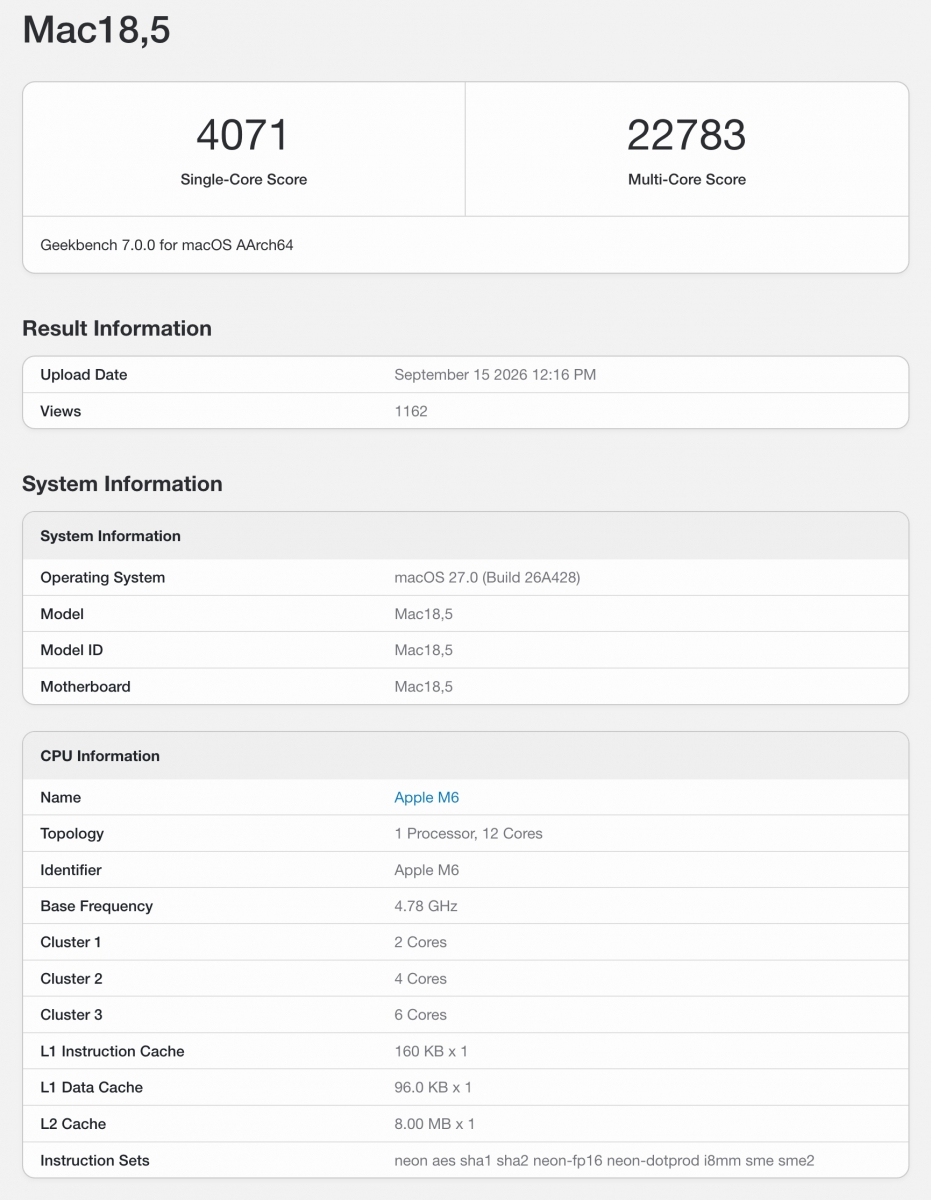
M1 Ultra reaches 23,328 points in the cited multi-core comparison, just 545 points, or about 2.3%, ahead of M6. That is a notable indication of CPU progress, but it does not make an M6 Mac mini equivalent to an Ultra-class system. M1 Ultra was designed with substantially greater graphics, memory and sustained-workload resources, while this comparison concerns CPU benchmark output alone.
GPU and AI performance remain untested
The initial result offers no view of the areas Apple has emphasized for M6 beyond CPU performance. The chip includes a 12-core GPU, neural accelerators in each GPU core, two 16-core Neural Engines and up to 170GB/s of unified-memory bandwidth. No M6 GPU result had appeared in Geekbench 7 when this CPU entry was reported.
Geekbench 7 also uses a methodology that differs from Geekbench 6, including changes to certain multi-threaded workloads. Scores from the two benchmark versions should therefore not be combined in the same performance ranking.
Apple says Mac mini configurations with M6 offer a 12-core CPU, a 12-core GPU and up to 32GB of unified memory, with shipments beginning September 22. Broader testing will determine whether the 22,783-point result holds across retail hardware and how M6 performs under sustained workloads, graphics tasks and local AI applications.