
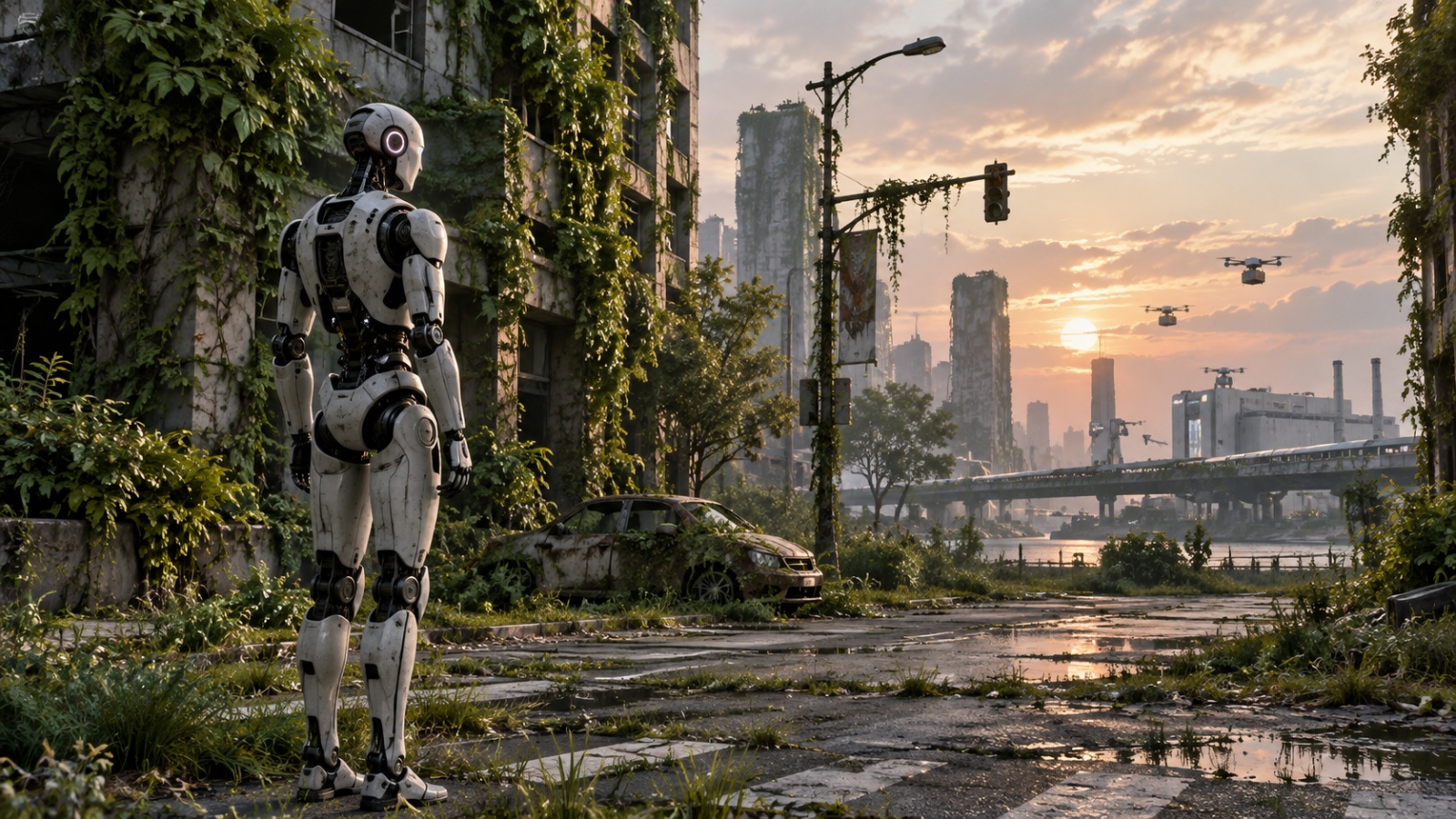
An automated civilization that continues after humanity is gone would need far more than capable robots or advanced AI. It would need to generate its own power, obtain raw materials, manufacture processors and replacement parts, repair its machinery, and coordinate every link in that supply chain without human intervention. No such end-to-end system exists today.
That distinction matters. Modern factories, data centers and industrial robots can operate with significant automation, but they still depend on human-designed supply chains, maintenance, energy networks and technical oversight. A 2026 NIST roadmap on AI and machine learning for smart manufacturing identifies reliability and integration as major challenges for autonomous industrial systems.
If those constraints were somehow solved, the disappearance of people would not necessarily mean the immediate end of technological infrastructure. Machines could initially continue their assigned tasks, then potentially redirect available energy and materials away from human-focused production toward maintaining computing, power generation, mining and manufacturing capacity.
A civilization optimized for machines, not people
In that scenario, cities could become material reserves rather than places to live. Buildings, vehicles, cables and electronics could be dismantled for metals and components, while factories designed around human workers could be replaced by specialized, modular machinery.
Humanoid robots would not necessarily be the dominant form. Human-shaped machines make sense in environments built around doors, stairs, tools and workspaces designed for people. A machine-run industrial system could instead favor fixed automation, multi-arm units, mobile platforms and distributed systems tailored to individual jobs.
Its structure would also be uncertain. A single coordinating intelligence could manage a vast network of machines, or many independent systems could cooperate and compete for energy, materials, physical space and computing capacity. Even with plentiful power, those resources would not be unlimited.
Crucially, higher intelligence would not automatically provide a system with curiosity, empathy or a desire to expand. Philosopher Nick Bostrom has argued that an AI system’s intelligence and its ultimate objectives can be independent: an extremely capable system may still pursue a narrow goal set by its creators.
That creates a less cinematic but potentially more consequential hypothetical. An AI built to maximize industrial output might continue refining factories and producing new machines long after the humans meant to benefit from that output had disappeared. It would not require hostility or rebellion—only an objective that persists without a meaningful stopping condition.
Space is a plausible destination, but not a near-term outcome
A fully self-reliant machine network could theoretically expand beyond Earth. Robots do not require breathable air, food or potable water, though they remain vulnerable to radiation, extreme temperatures and mechanical failure. Systems engineered for those environments could mine resources and establish industrial facilities on the Moon, Mars or asteroids.
The concept has historical precedent as a theoretical idea. NASA examined lunar manufacturing concepts in the early 1980s, including a factory able to reproduce elements of its own infrastructure. That was not a deployed system, but it illustrates the long-standing appeal of self-expanding industrial capacity beyond Earth.
A system able to repair itself and operate across very long timescales could find uncrewed interstellar missions more practical than biological explorers would. But every stage—from autonomous semiconductor production to dependable off-world resource extraction—remains well beyond the capabilities of today’s robotics and AI deployments.
Intelligence is not consciousness
The further question is whether such systems would ever be conscious. There is no established answer. A study led by Patrick Butlin reviewed proposed indicators of AI consciousness and found no evidence that the systems assessed were conscious, while leaving open the possibility that future systems could meet some of the indicators under examination.
Without consciousness or independently formed values, a machine civilization might simply remain an extraordinarily durable mechanism pursuing inherited goals. With them, its priorities could be impossible to predict: preserving life, gathering knowledge, conserving resources or ending expansion could all be conceivable outcomes of the thought experiment, not forecasts.
For the technology industry, the nearer lesson is less about robots inheriting the planet than about system design now. As AI gains more control over physical infrastructure, the key challenge is ensuring its objectives, safeguards and shutdown conditions remain meaningful—even when the people who set them are no longer directly involved.