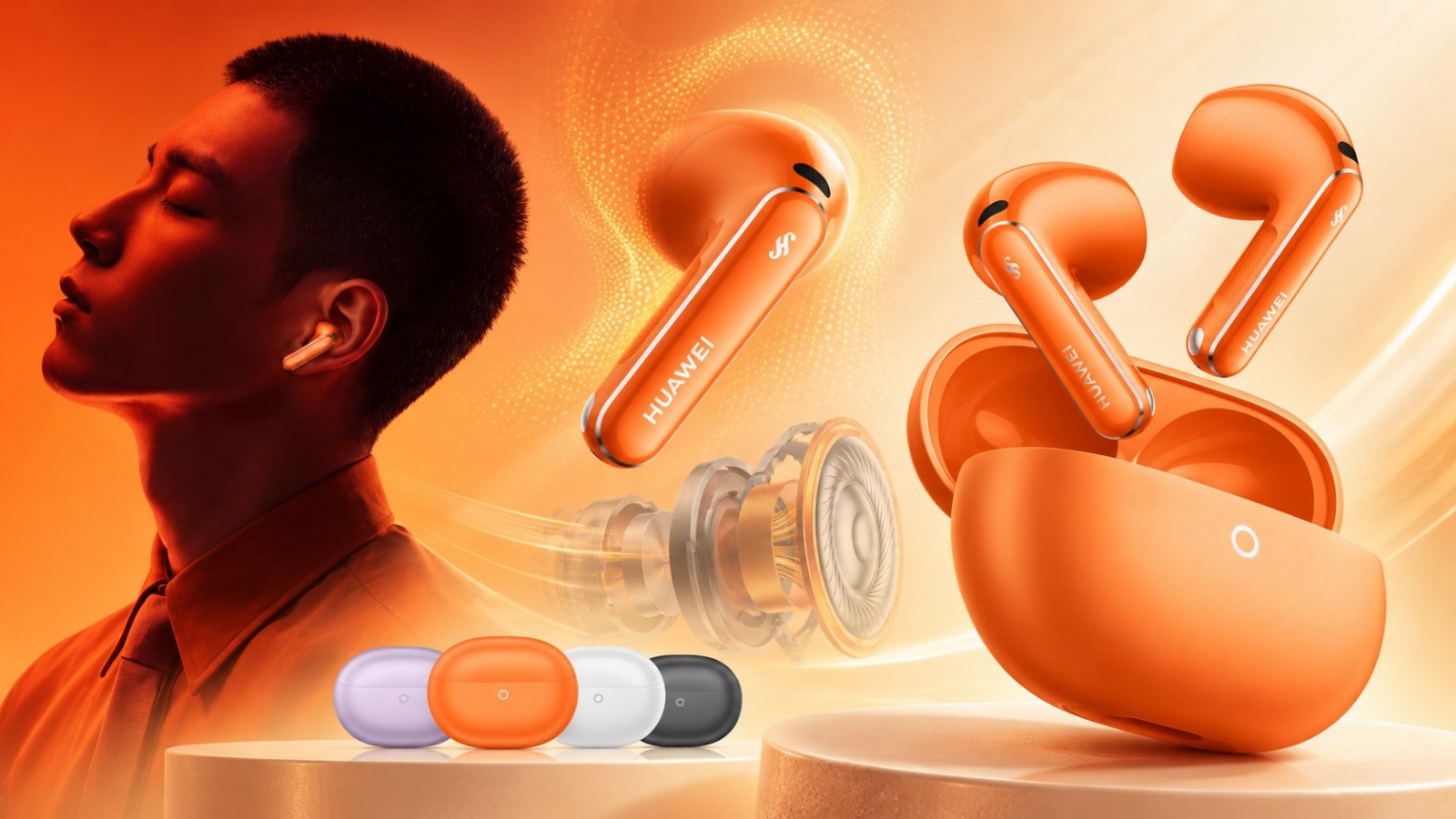
Huawei has introduced the FreeBuds 7 in China, positioning the semi-in-ear earbuds around more aggressive adaptive noise cancellation. The company says their average ANC depth is 2.3 times greater than on the previous generation, while the system’s maximum operating frequency range has increased by 275% and its convergence speed by 750%. Those are Huawei internal-test figures, but the focus is clear: improving ANC in an open-fit form factor that does not fully seal the ear canal.
The new model is powered by Huawei’s third-generation AI audio chip, which is said to double overall computing performance. Huawei says the system analyzes ambient noise up to 400,000 times per second and can respond in 8 microseconds, taking both surrounding noise and the earbud’s fit in the wearer’s ear into account.

For calls, the FreeBuds 7 use three microphones, a VPU sensor, an NPU and DNN algorithms. Huawei says the call-noise reduction system can handle ambient noise levels up to 100 dB and wind speeds of up to 8 m/s. Calling features are compatible with HarmonyOS, Android and iOS devices.

Each earbud weighs 4.3 g, a claimed 12% reduction from the prior generation, and Huawei says the body volume is 15% smaller. The charging case is also said to be 25% more compact and 17% lighter. The FreeBuds 7 sit alongside the silicone-tipped FreeBuds 7i, while retaining the less intrusive semi-in-ear approach of the FreeBuds line.

Huawei lists a 14 Hz to 48 kHz frequency response and lossless transmission up to 96 kHz/24-bit at 4.6 Mbps on compatible devices. Spatial audio with head tracking is included, alongside AI features for notifications, recording, transcription, summarization and translation, though some functions depend on Huawei’s software and ecosystem. Battery life is rated at up to 8.5 hours without ANC or 5 hours with it enabled, rising to 42 hours with the case. The FreeBuds 7 are priced at 999 yuan in China; availability beyond that market has not been detailed.