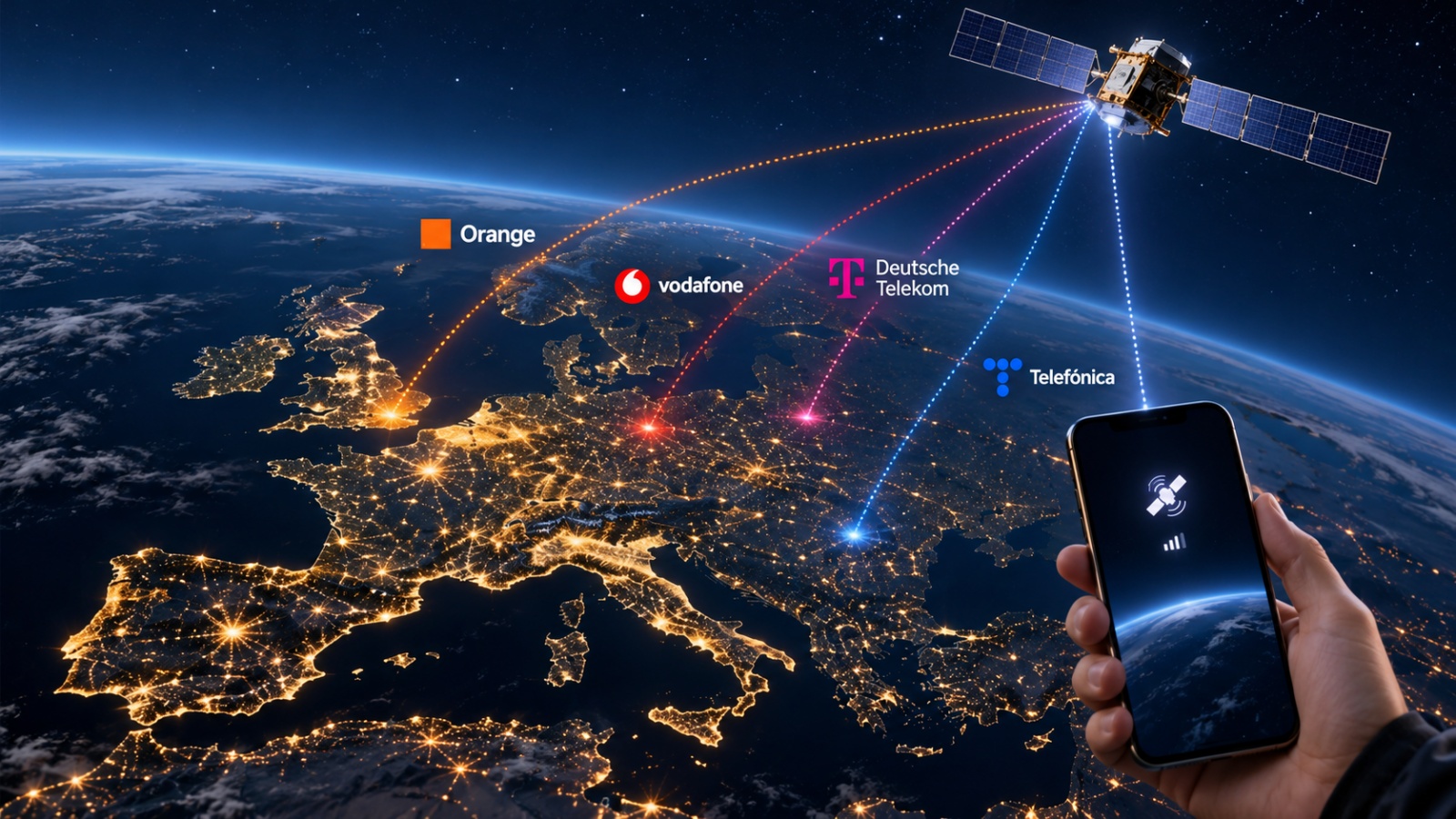
Orange, Vodafone, Deutsche Telekom and Telefónica have signed a letter of intent to examine a joint bid in a future spectrum allocation for mobile satellite services. The move could help the operators develop direct-to-device connectivity that extends mobile coverage beyond the reach of terrestrial networks.
Direct-to-device, or D2D, technology allows compatible phones to connect directly to satellites without a dedicated antenna or terminal. Operators see it as a way to supplement conventional coverage in remote locations and during outages that affect ground-based infrastructure.
The four companies are not planning to build their own satellite constellation. Instead, they intend to retain control of terrestrial infrastructure, coordination centers and service monitoring in Europe, while relying on a specialist satellite partner that has yet to be selected.
- The planned platform would be open to European operators beyond the four founding companies.
- Satellite links would be designed to complement existing 4G and 5G networks.
- The proposal aims to keep critical terrestrial infrastructure and service oversight under European control.
- The service could add connectivity capacity when terrestrial networks are unavailable in an emergency.
The agreement does not replace the operators’ existing satellite initiatives. Orange and Vodafone have already conducted satellite-connectivity tests with AST SpaceMobile and Satellite Connect Europe, respectively, while the new effort leaves the group able to assess more than one potential supplier and network model.
No commercial launch timetable, pricing, supported handset list or satellite partner has been announced. The next key step will be the future spectrum process and whether the operators can turn their shared bid into an operational D2D service.