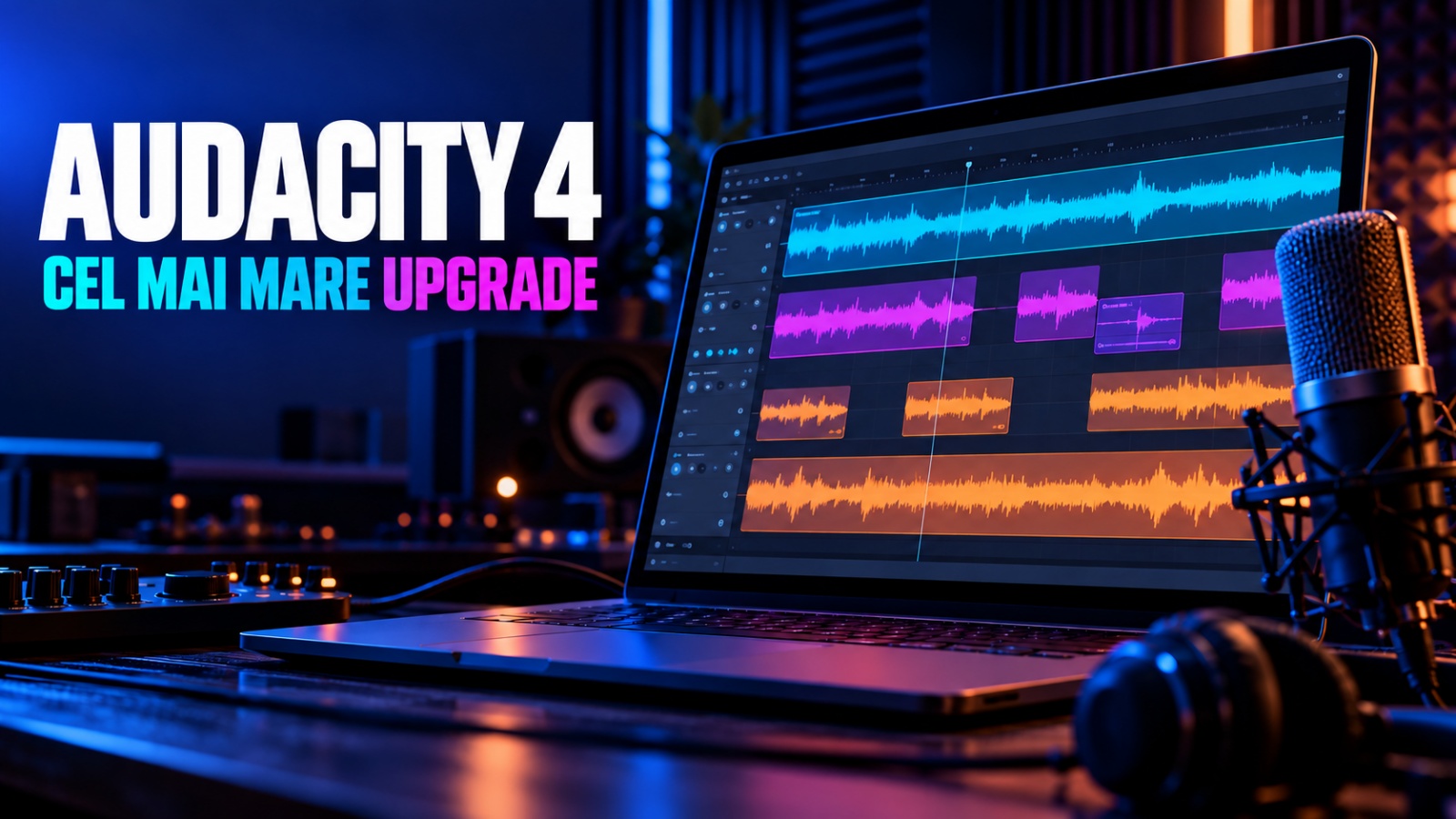
Audacity 4.0.1 is now available for Windows, macOS and Linux, delivering the largest overhaul yet for the long-running open-source audio editor. The release rebuilds the application on Qt and changes core editing workflows, including direct multi-clip selection, movement and resizing.
Audacity 4 is here.
Audacity team
First released in 2000, Audacity has surpassed 100 million downloads. Its free recording, trimming, cleanup, effects and export tools have kept it widely used, but its interface had increasingly felt dated next to modern digital audio workstations and video-editing software.
The new release lets users select clips directly and move, resize or stretch multiple segments at once; clips can also be grouped. A dedicated split tool is available by holding S and clicking the waveform. Recording can begin from any position on the timeline, rather than requiring users to return to a track’s end, and each track now has its own playback and recording level meter.
- Saved workspaces let users move, hide, dock or detach panels and preserve a preferred layout. Built-in workspace options include Modern, Classic and Music.
- The spectrogram has clearer guides and faster rendering, while effects, generators and analyzers have controls adapted for the redesigned interface.
- Projects in the older .aup3 format can be opened and converted to .aup4 without changing the original file. Converted projects cannot be saved back to .aup3.
- Version 4.0.1 adds export support for multiple tracks or labeled regions, restores some Audacity 3 keyboard shortcuts and offers a portable Windows build that runs without installation.
Compatibility gaps remain
Audacity 4 does not yet include every feature from the version 3 line. The current omissions are Time Tracks, MIDI tracks, Mixer, Macro Manager, the scripting pipe, VAMP and LADSPA support, and variable-speed playback.
That may have limited impact on straightforward voice, podcast and video-audio editing, where the redesigned clip controls and workspace management are the most immediate changes. Users dependent on legacy plug-ins, macros or more complex music projects may need to retain Audacity 3, particularly because .aup4 conversions cannot be reversed into the older project format.