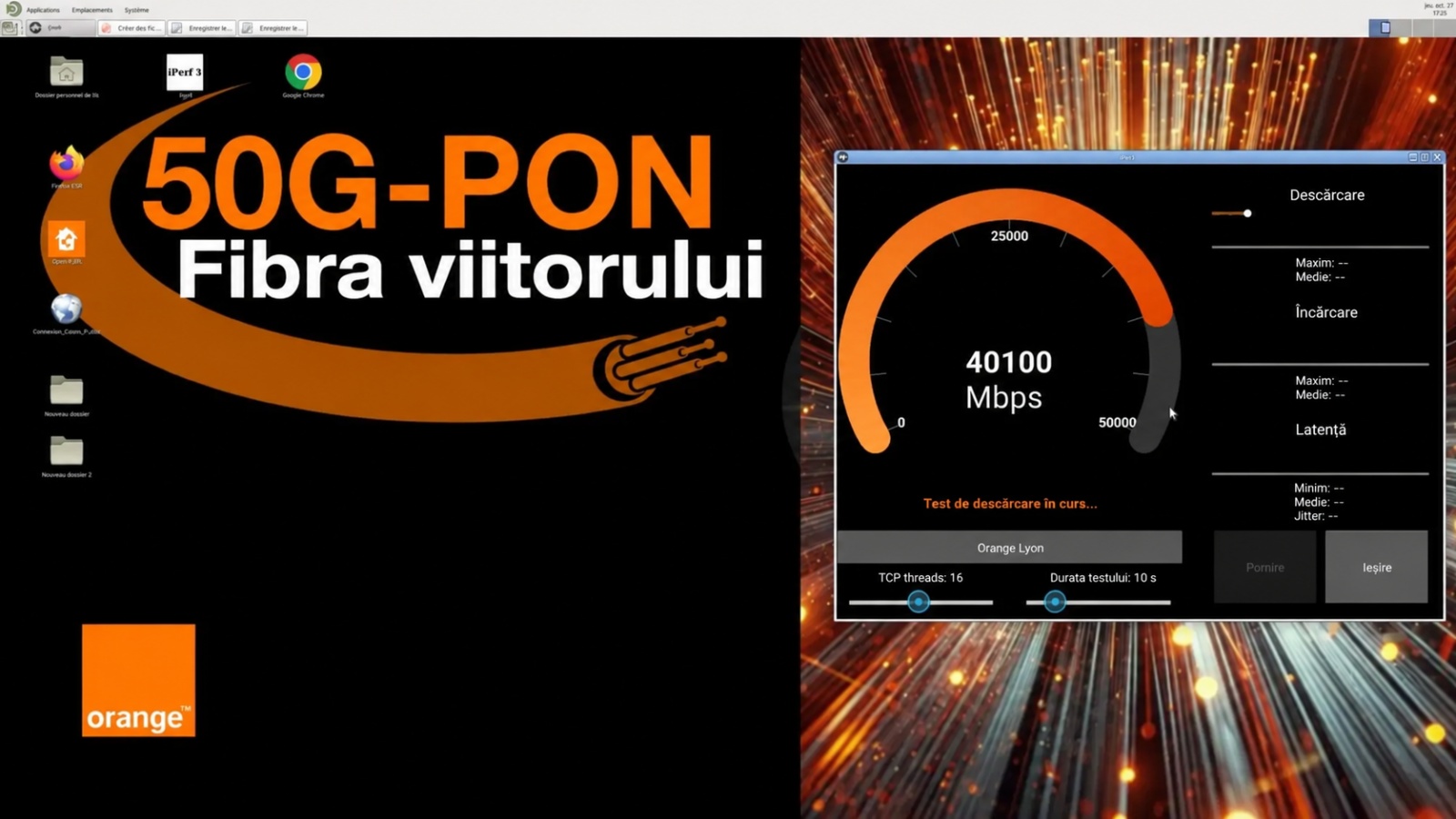
Orange has demonstrated fiber connections delivering about 40 Gbps in both download and upload tests using 50G PON technology. The single-PC lab trial also recorded latency below one millisecond, though the operator has not announced a commercial service or launch timetable.
The 50 Gbps figure in the technology’s name is the line’s nominal capacity. Transmission overhead and error correction reduce the usable data rate, with Orange describing the approximately 40 Gbps result as the maximum theoretical throughput available in its test.
50G PON is the next generation of passive optical networking after XGS-PON, which has a nominal capacity of 10 Gbps. Orange says the newer standard can coexist with GPON and XGS-PON on the same fiber infrastructure by using different wavelengths, potentially allowing upgrades without replacing the fiber running to a customer’s premises.
- Higher capacity: up to 50 Gbps nominal downstream capacity, five times that of XGS-PON.
- Shared fiber upgrades: 50G PON can operate alongside GPON and XGS-PON through separate wavelengths.
- Low latency: Orange measured latency below one millisecond in its test, a characteristic relevant to delay-sensitive industrial workloads.
- Mobile-network transport: the fiber connection can carry traffic between 5G radio sites and the wider network.
- Multi-service infrastructure: the same physical network can support residential, business and mobile traffic.
- Potentially lower energy use per bit: Orange says carrying more data through the same active equipment may reduce energy consumption relative to transferred data.
The equipment used in the trial can support all three PON generations on one port and connect up to 128 customers on a single fiber. That bandwidth is shared, however, so the result does not imply that every connected customer would receive 40 Gbps simultaneously.
Orange has previously tested the coexistence approach in France. In 2024, it said a customer on a live 50G PON network exceeded 41 Gbps while other subscribers continued to use GPON and XGS-PON services.

What 40 Gbps could enable
Orange estimates that transferring a 1 TB video source file at 40 Gbps could take roughly five minutes, compared with about an hour at 2 Gbps. Actual transfer times would also depend on servers, client hardware and storage performance.
The lab demonstrations included remote editing of cloud-hosted video, using server storage as a local disk, large-file transfers and downloading AI models for use on local servers. Orange also sees potential applications in university campuses, inter-site backup, data centers, cloud gaming and virtual reality.
End-user hardware would be a major constraint for any eventual 40 Gbps service. A 1 Gbps Ethernet port cannot use bandwidth beyond its own limit, meaning compatible routers, network adapters and client devices would be required. Orange says it will continue 50G PON testing for homes, businesses and mobile-network transport, with commercial availability still unconfirmed.