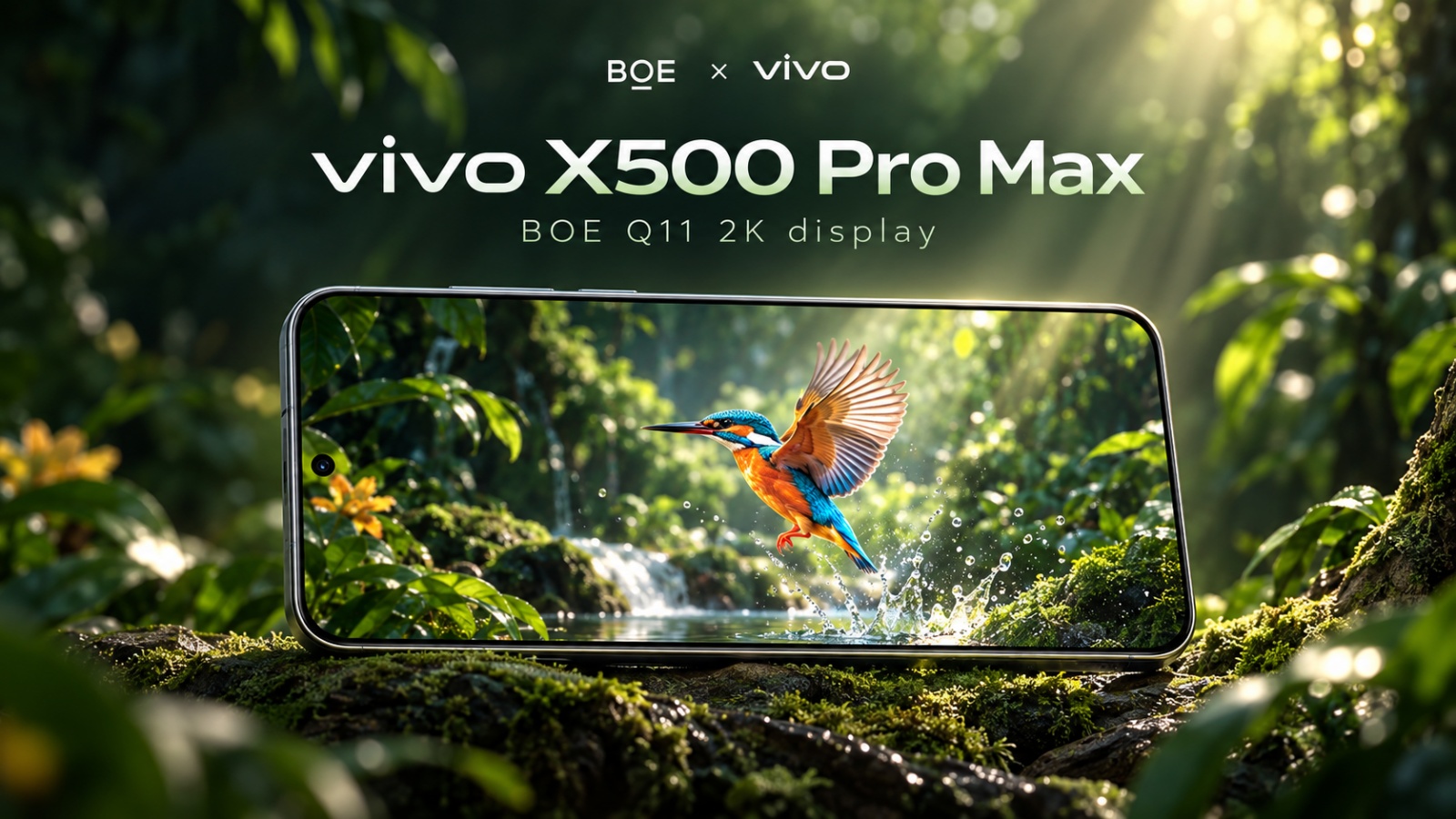
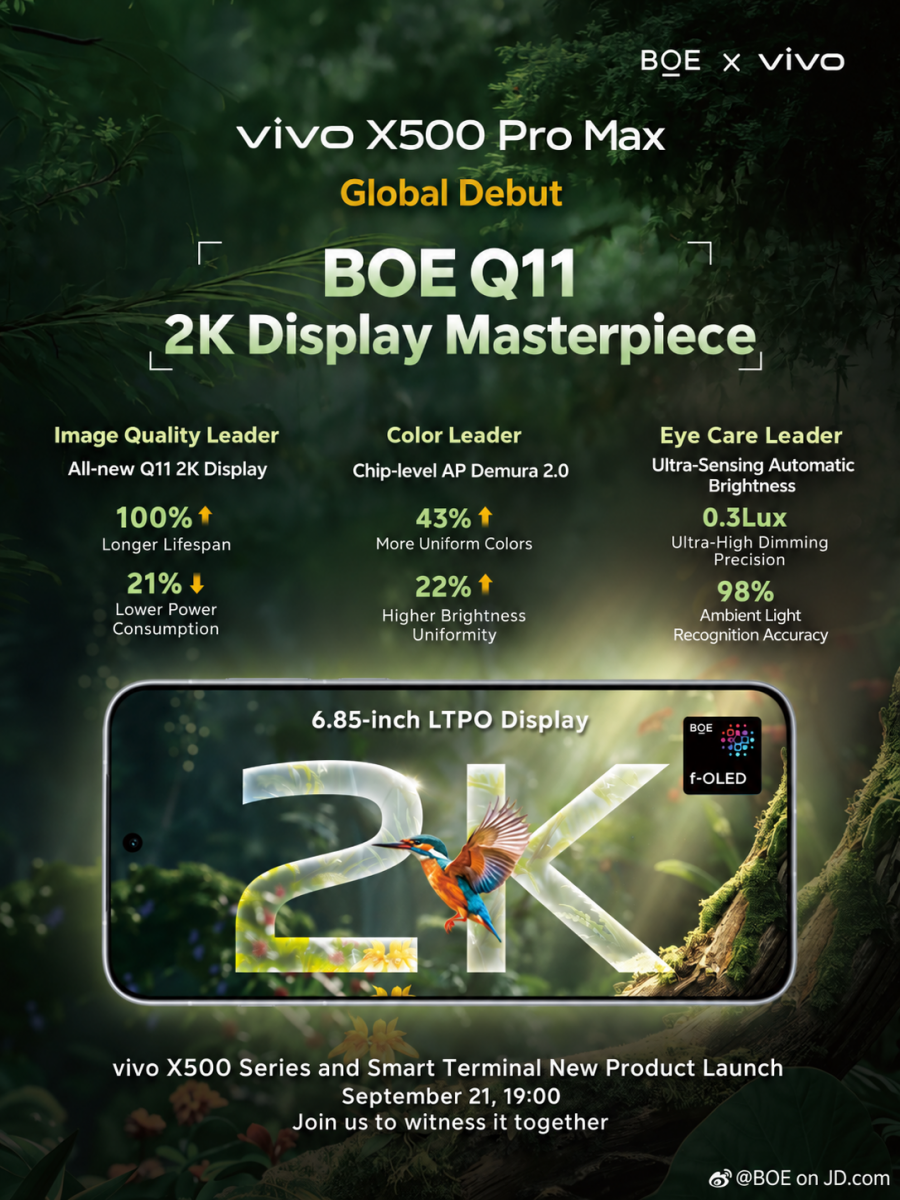
vivo has detailed the display planned for its upcoming X500 Pro Max, saying the flagship will use a 6.85-inch BOE Q11 OLED panel with 2K resolution. The company claims the new luminous material cuts power consumption by 21% compared with the 1.5K display used previously, while also targeting OLED longevity and screen uniformity.
- 6.85-inch display with 2K resolution
- 21% lower claimed power consumption versus the previous 1.5K panel
- A claimed doubling of display lifespan
- 93% less motion blur while scrolling
- 43% better color uniformity
- 22% better brightness uniformity
- An under-display multispectral sensor for automatic brightness and color-temperature adjustment
The figures come from vivo and will need independent testing. Beyond the new OLED material, vivo points to pixel-level calibration and the multispectral sensor as part of its approach to more consistent color and brightness. The X500 Pro Max is also expected to pair the screen with MediaTek's Dimensity 9600 Pro and a ZEISS-branded camera system that includes a 200-megapixel telephoto camera.
BOE Q11 enters a broader flagship OLED contest
The X500 Pro Max arrives as display suppliers increasingly emphasize panel efficiency and durability alongside resolution and refresh rate. Samsung Display's M16 OLED material, used in the iQOO 16, follows a similar direction, although the companies use different comparison baselines for their power-consumption claims.
| Feature | vivo X500 Pro Max | iQOO 16 |
|---|---|---|
| OLED material | BOE Q11 | Samsung Display M16 |
| Display size | 6.85 inches | 6.9 inches |
| Resolution | 2K | 2K |
| Claimed power-consumption improvement | 21% lower than vivo’s previous 1.5K display | About 30% lower than a previous 1.5K, 165Hz gaming panel |
| Refresh rate | Not specified | 165Hz |
Samsung Display has also stated that the iQOO 16 panel can reach up to 2,800 nits in high-brightness mode. That does not make its efficiency figure directly comparable with vivo's Q11 claim, but both announcements show OLED competition shifting toward power use, uniformity, brightness and material lifespan rather than pixel counts alone. Independent testing will determine whether Q11's promised gains hold up beyond vivo's pre-launch figures.