
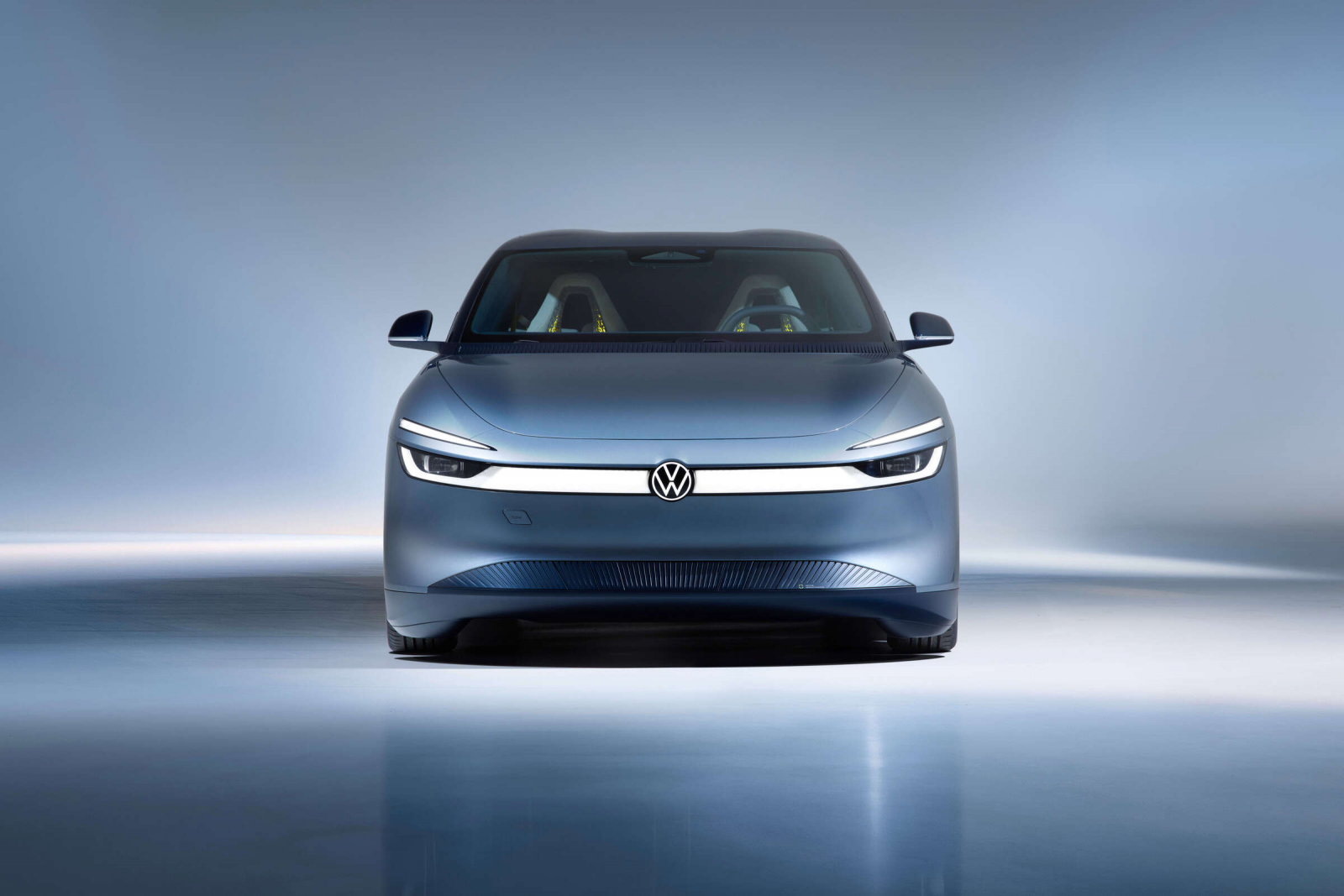
Volkswagen’s Mission Efficiency concept has completed a 1,278 km drive from Wolfsburg to Vienna with just one charging stop, posting energy consumption of 7.51 kWh/100 km when charging losses were included. The near-production concept is Volkswagen’s argument that aerodynamic improvements can add meaningful EV range without simply fitting a larger battery.
The car used a 54.9 kWh net battery, a 99 kW front motor and Volkswagen’s MEB+ platform. On the Wolfsburg-Vienna route, its consumption was measured at 6.89 kWh/100 km before charging losses. In a separate idealized run at a constant 68 km/h with climate control switched off, Volkswagen recorded 6.48 kWh/100 km.
Its key figure is a 0.158 drag coefficient. Volkswagen achieved that through a body measuring 4.775 meters long but only 1.392 meters high, a 2.08-square-meter frontal area, and extensive work to control airflow around and beneath the vehicle.
- The rear track is narrowed by 170 mm.
- The rear wheels are covered.
- The underbody is fully enclosed.
- Three active flaps manage cooling across five configurations.
- The tires have rolling resistance about 25% better than the threshold for Europe’s highest tire class.
Volkswagen says the changes matter particularly at highway speeds. From 80 km/h upward, Mission Efficiency uses more than 30% less energy than the ID. Polo, according to the company. At 140 km/h, it is said to require roughly the same energy as the ID. Polo at 100 km/h.
A long, low concept meets a compact-EV policy debate
The concept also illustrates a potential tension in European EV policy. The European Commission has proposed a category, beginning in 2030, that would favor EU-built electric cars no longer than 4.2 meters in an effort to encourage more compact, affordable models. At 4.775 meters long, Mission Efficiency would exceed that proposed limit.
That length is central to the concept’s efficiency rather than incidental: its long, tapered rear section contributes to the low-drag profile. The case also highlights that battery-electric vehicles are treated as zero-emission at the tailpipe in fleet-emissions calculations regardless of whether they consume around 6.5 kWh/100 km or 25 kWh/100 km.

Volkswagen has not announced production plans for Mission Efficiency. Still, the concept uses technologies that could move into mainstream vehicles, including active cooling control, underbody optimization, low-rolling-resistance tires and other aerodynamic measures. It also carries 370 W of photovoltaic panels integrated into the roof and tailgate, although those panels are not presented as the main reason for its low consumption.
Its three records were certified in the category for production-near, everyday-usable four-seat electric cars. Whether the unusual body shape reaches a showroom remains unconfirmed, but the project puts the focus on an increasingly important EV question: how much range can be gained by reducing energy demand before adding more battery capacity?