
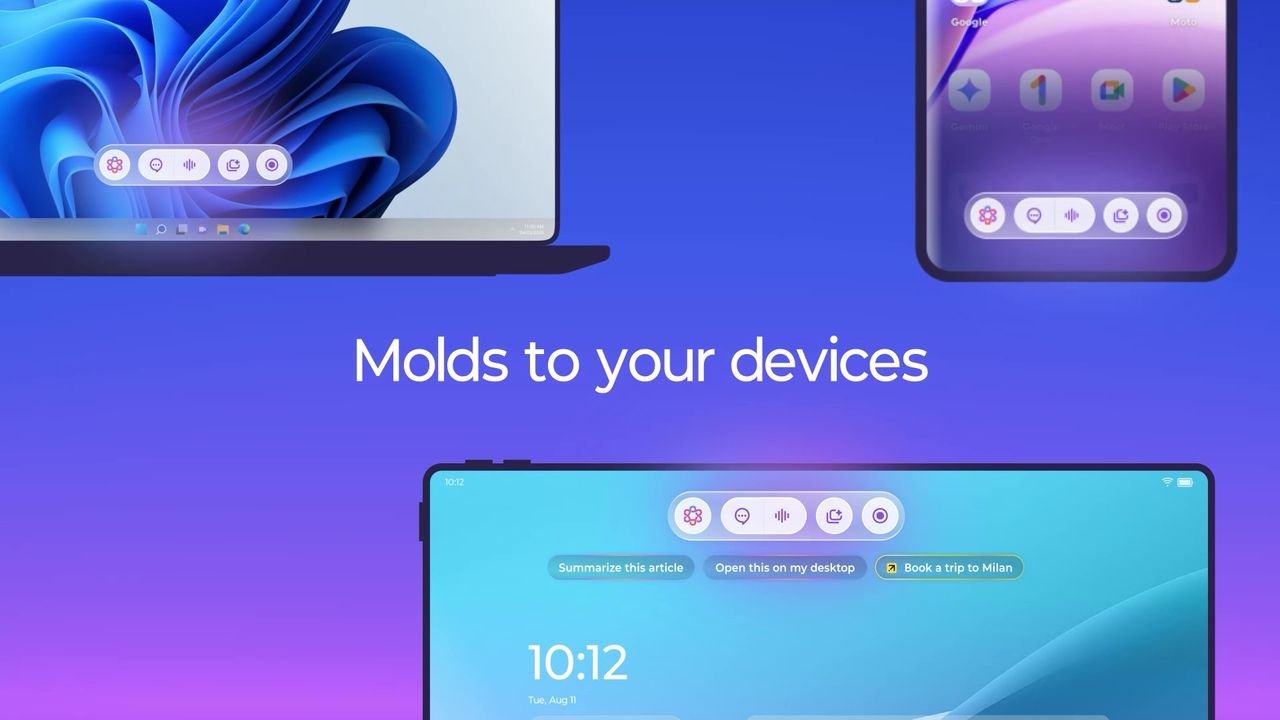
Lenovo is extending its Qira personal AI platform beyond PCs to eligible Motorola smartphones and, for the first time, a Motorola smartwatch. The company’s stated goal is a single assistant that can retain context as users move between devices, rather than separate AI experiences on each product.
The expansion also lowers the PC memory requirement for Qira. Eligible Lenovo computers with 16GB of RAM will be able to use the platform, opening it to systems beyond the high-memory configurations previously supported.
On mobile, compatible Motorola Edge, Razr and Signature-series phones are set to gain Motorola Qira with their Android 17 update. Lenovo’s newly announced moto watch ultra is the first Motorola wearable to support Qira when paired with compatible devices.
Lenovo is also working with Workato to connect compatible Qira experiences with Gmail, Google Calendar, Google Contacts, Slack, Outlook Mail and Outlook Calendar. The integration is designed to let the assistant use information from connected services to turn requests into actions, reducing the need to manage each app separately.
The Qira push was announced alongside a wider Lenovo device strategy focused on local and hybrid AI. The Yoga Pro 9n and Yoga 9n 2-in-1 bring NVIDIA RTX Spark to the Yoga range for local AI and creative workloads, while the Yoga Tab Plus Gen 2 and Yoga Tab Gen 2 continue the company’s pen-focused tablet line. Lenovo also demonstrated Smart Canvas Concept, an experimental platform for developing ideas across compatible devices using voice, a stylus, camera input and touch controls.
For business users, Lenovo named the ThinkCentre X Ultra, ThinkCentre M75 Series, ThinkBook 14 Gen 9 and ThinkBook 14x Gen 2 as systems intended for local AI tasks where company data does not need to be continuously sent to the cloud. Its Hybrid AI approach combines on-device processing, edge infrastructure and cloud services according to the workload.

The company also introduced ThinkShield TraceLock, based on Absolute Security technology, for device visibility and control. Separately, it highlighted an integration of Prompt Security technology from SentinelOne aimed at managing and governing generative AI use in organizations.
Lenovo has not detailed a broader rollout timetable or a full device-by-device eligibility list for Qira. Those details will determine how quickly its cross-device assistant can become a practical alternative to the separate AI tools now appearing across PCs, phones and wearables.